
Breaking down the microbiology world one bite at a time
Artificial Evolution — How AI Can Accelerate Our Fight Against Antimicrobial Resistance
Artificial intelligence (AI) is everywhere. Every time you search for something online, you are likely first met with an AI overview of the topic you were looking for. While the benefits of AI in our personal lives are subject to debate, scientists are now using this technology as a tool to fight antimicrobial resistance.
Antimicrobial resistance occurs when microorganisms evolve to survive repeated exposure to antibiotics or other antimicrobial compounds. As more and more people use antibiotics to treat bacterial infections, this survival mechanism is on the rise. Unfortunately, the rate of new antibiotic discovery has not been able to keep up, and more and more people are dying due to antimicrobial-resistant pathogens each year.
So, how do we combat this issue? Many scientists are turning to other microorganisms to fight this cause. For instance, bacteriophages are viruses that can target and kill specific bacterial species. Unlike broad-spectrum antibiotics, their impact on beneficial bacteria is more limited, making them a hot topic in the antimicrobial resistance field. In fact, phage therapy has successfully been used to treat people with multidrug-resistant bacterial infections.
Yet we still have a major problem. Only so many bacteriophages exist in the world, and they can only evolve to kill specific bacteria so quickly. This is where AI comes into play. In this study, the authors wondered: can we use AI to design new bacteriophages able to fight bacterial infections?
To answer this question, the authors used two large language models trained on over 2 million bacteriophage genomes. They then chose the well-described phage ΦX174, known to target Escherichia coli, as a reference template to build new phages. Using fine-tuned prompts, the researchers generated 302 bacteriophage genomes with the potential to kill E. coli (figure below).
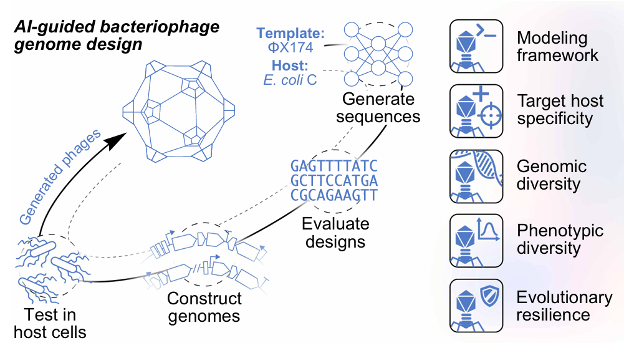
But can AI-generated genomes actually produce fully functioning bacteriophages? To address this question, the authors assembled these genomes in the lab before testing their ability to kill bacteria. Of the 302 genome candidates, 285 were successfully built, and dozens were able to inhibit the growth of two different strains of non-pathogenic E. coli.
Finally, the authors tested AI-generated phages’ ability to inhibit the growth of antimicrobial-resistant bacteria. They selected E. coli strains resistant to the natural phage ΦX174 and exposed them to various phage mixtures. Unlike ΦX174, AI-generated phages overcame bacterial resistance over time, seemingly accumulating genetic pieces from one another in an evolutionary process resembling natural selection.
Altogether, the researchers successfully used AI to construct viable bacteriophages with the potential to evolve quickly in order to evade antimicrobial-resistant bacteria.
This finding marks a breakthrough in how scientists are thinking about antimicrobial resistance and phage therapy. It opens up a wide range of possibilities for therapeutics that can fight bacteria resistant to most, if not all, antibiotics at our disposal.
Whether you are for or against the widespread use of AI in our day-to-day lives, it is clear that this technology can significantly benefit the field of microbiology. In the war against antimicrobial resistance, we need all of the help we can get, and this work highlights how AI can support us in the fight.
Link to the original post: King SH, Driscoll CL, Li DB, et al. Generative design of bacteriophages with genome language models. Science. 2026;393(6811):eaec2657
Featured image: Made by author in BioRender