
Breaking down the microbiology world one bite at a time
The Hidden World in Our Fermented Food
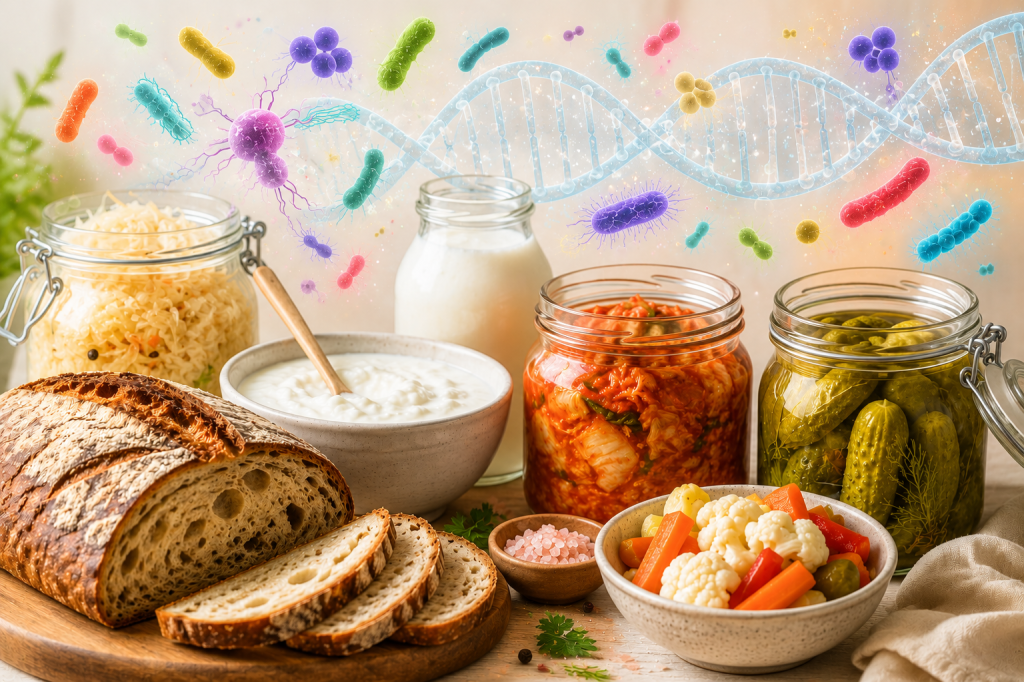
For a long time, humans have consumed unintentionally fermented food as part of custom without knowing the microbial community responsible for creating it. A jar of fermented food may look simple; however, inside that food is an invisible ecosystem. Bacteria, yeasts, and other microorganisms interact, compete, and cooperate to create the flavours, textures, and characteristics we know. But what if some of the most important microbes in yogurt, sourdough, kimchi, or other fermented foods have never been grown in a laboratory?
Fermentation itself is part of ancient history, but systematic study of microbes is quite recent. Scientists have studied fermented food microbes with tools developed over the decades. This has led to controlled fermentation processes with standardized production and predictable results. However, only a small fraction of these diverse microbes has been unearthed, as many microorganisms are difficult to grow under optimal laboratory conditions, limiting the potential applications of the microbial community. Recent cutting-edge technology, metagenomics, helps to study microbes that cannot be grown in the laboratory.
Metagenomics is different from classical microbiology methods that study microbes by isolating and propagating them; instead, it focuses on the total genome sequence. Scientists extract DNA from fermented food samples and sequence the genetic material. Moreover, Bioinformatics tools analyse these genomes while identifying and separating known microbes from unknown species. Metagenomics is capable of investigating the total genomic material from an ecological niche and revealing community structure and its activities, along with the dynamic changes during fermentation. An advantage of metagenomics over classical methods is that exploration of the entire microbial community at once is possible, but finding a gene doesn’t always mean it is active or that any predicted function occurs because of the gene.
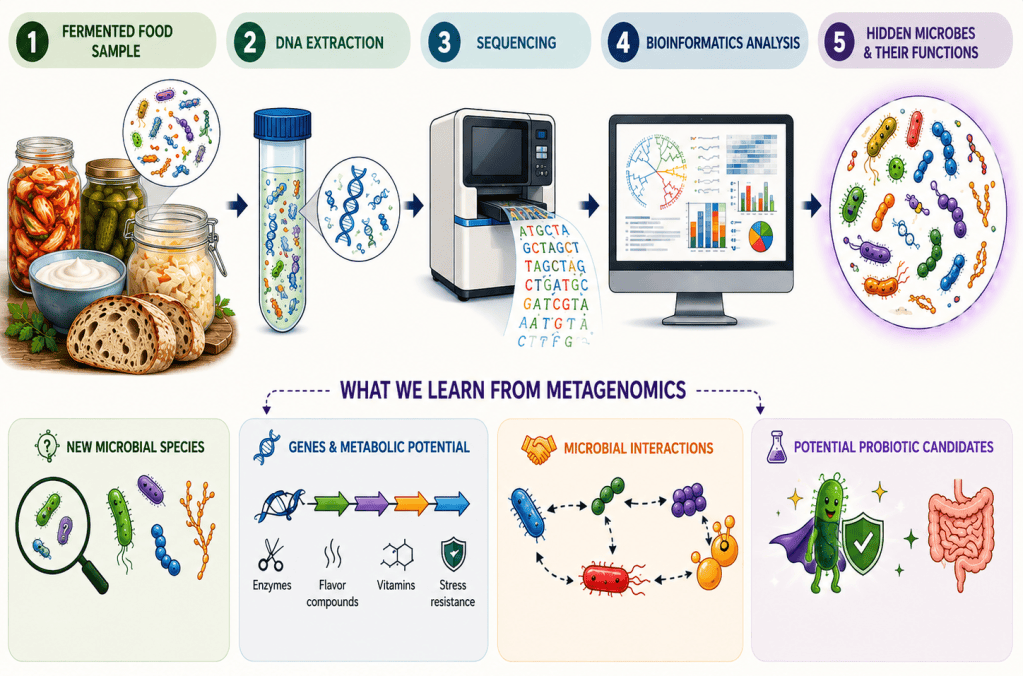
Metagenomic studies have detected genetic signals different from known microbial species. Researchers are able to identify both known and unknown organisms. Both traditional methods and metagenomics show that Lactic Acid Bacteria (LAB) are the protagonists in food fermentations. But other interesting facts have been discovered using metagenomics: a large analysis of more than 2500 food metagenomes identified approximately 300 novel food-specific microbial species. More than half of these species are unlike any currently known genus. Also, a potential Oenococcus species has been identified in water kefir. It seems that every time scientists sequence these microbial communities, they may be opening a door into a biological world that has been quietly shaping our food for generations.
Metagenomics not only discovers new species, but it can help scientists investigate the functional potential of the microbes. The focus shifts from identity to function. Researchers highlight that reconstructed genomes can be used not only for taxonomic identification and strain-level analysis. But clues from these analyses about the metabolic abilities that are relevant to nutrient transformation, flavour development, survival in food environments, and fermentation processes can also be utilized.
Several case studies by the researchers indicate that it is possible to rebuild a microbial community for fermentation. Scientists have, for example, identified microbes that are associated with flavour development during cocoa fermentation. They carefully selected a group of microorganisms to mimic the natural process and experimented in controlled fermentation. The experimentally fermented cocoa reproduced the same properties as the spontaneously fermented seeds.
Moreover, researchers have used metagenomics (and metatranscriptomics, which shows which microbial genes are being actively used) to identify important microbial strains for spontaneous sourdough fermentation. This shows that metagenomics is helping scientists to understand the microbial combinations necessary for reproducing fermented products, which could reduce failed fermentation processes and food waste. Additionally, the discovery of different potential probiotics is promising. Probiotics are beneficial live microorganisms that provide various health benefits when consumed in sufficient amounts. Common sources of probiotics are yogurt, fermented milk drinks, kefir, etc. However, adequate laboratory testing and clinical studies are necessary for screening probiotic candidates, which emphasizes that these computational approaches are still developing and require further validation.
Every potential application has certain limitations. As the extracted genetic data are massive and complex, standardized and reliable data analysis methods are necessary to extract meaningful information from the genetic materials. Also, the difficulty of describing the link between genetic potential and microbial functionality is tremendous. In the future, metagenomics could be combined with other tools such as metabolomics (molecules produced by microbes) and metatranscriptomics (active genes of microbes) to get a complete picture of fermented food microbes.
Next time people enjoy yogurt, kefir, or sourdough, they will surely remember the invisible ecosystem behind that food. The diversity and functionality of different microbes connect centuries of tradition with modern science.
Link to the original post: Valentino, V., De Filippis, F., & Ercolini, D. (2026, June 22). Fermented foods: lessons learned from metagenomics. Current Opinion in Biotechnology, 100. ScienceDirect. https://doi.org/10.1016/j.copbio.2026.103545
Featured image: generated using ChatGPT