
Breaking down the microbiology world one bite at a time
The Real-Life Asgardians
According to Norse mythology, Asgard is a heavenly realm and home to legendary Asgardian gods such as Odin, Thor, and Loki. Billions of years ago, in the real world, a group of microscopic “Asgardians” emerged. These Asgardians are none other than a group of archaea naturally found in diverse environments, and they might hold clues to one of the biggest mysteries in the evolution of life on Earth.
All living organisms on Earth can be divided into two primary groups based on their cell type: eukaryotes and prokaryotes. Prokaryotes, comprising Bacteria and Archaea, represent some of the earliest forms of cellular life on Earth. The emergence of eukaryotes is estimated to have occurred approximately 2.3 to 2.1 billion years ago. The origin of the eukaryotic cell, or eukaryogenesis, is believed to have occurred through the merging of an ancestral archaeal host cell and an endosymbiotic bacterium. It is suggested that the bacterium lived within the archaeal host cell and, over time, evolved into the eukaryotic mitochondria. However, the precise sequence of events leading to the emergence of the first eukaryotic cell remains an active area of research. Some clues about this topic have been recently uncovered by scientists.
One of the mysteries related to this topic is the nature of the archaeal host cell. There is growing evidence that the host cell might have been a member of the superphylum known as Asgard archaea. In reference to Norse mythology, the lineages of Asgard archaea are named Lokiarchaeota, Thorarchaeota, Odinarchaeota, and Heimdallarchaeota. Asgard archaea are currently considered to be the archaeal lineage most closely related to eukaryotes. They even encode proteins that are required for basic eukaryotic functions, such as cytoskeletal mechanics, endomembrane trafficking, intracellular signaling, and vesicular transport. Therefore, understanding the biology of Asgard archaea could help answer questions about eukaryogenesis. However, research on this group of archaea has been limited by their difficulty in cultivation and slow growth rates.
After years of effort to cultivate Asgard archaea, researchers have managed to cultivate two species: the first being Prometheoarchaeum syntrophicum and the second, Candidatus Lokiarchaeum, named after Loki, the Norse god of mischief. Both species require a syntrophic partner, meaning that the organisms work together by exchanging metabolites that support their survival. Since the discovery of Asgard archaea, it has been proposed that a syntrophic relationship between Asgard archaea and bacteria could have contributed to eukaryogenesis. In addition, one model proposes that eukaryogenesis may have occurred in Paleoproterozoic microbial mats, where such syntrophic relationships existed. Microbial mats can be defined as “thick, layered biofilms in which different organisms interact and exchange compounds to acquire energy and nutrients, developing metabolic interdependencies essential for survival”.
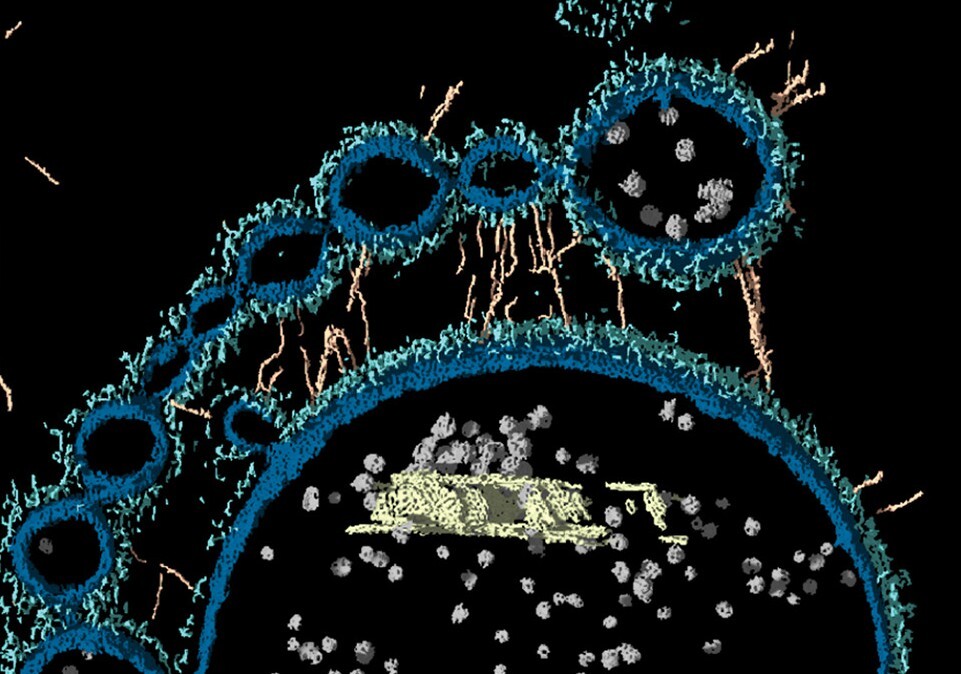
Today, microbial mats still persist, such as the hypersaline intertidal mats of Shark Bay in Western Australia. The microbial mats of Shark Bay serve as an analogue of ancient mats and are dominated by Asgard archaea in their subsurface. Most recently, researchers were able to cultivate a third Asgard archaeon from the Shark Bay microbial mat and observed its syntrophic relationship with a sulfate-reducing bacterium. This novel Asgard species was named Nerearchaeum marumarumayae. Under electron cryotomography (cryo-ET) the archaeon had a coccoid morphology, with chains of budding vesicles and tubular cytoplasmic extensions that were attached to the main cell body through extracellular fibers. Researchers also identified proteins in N. marumarumayae that are similar to certain eukaryotic proteins.
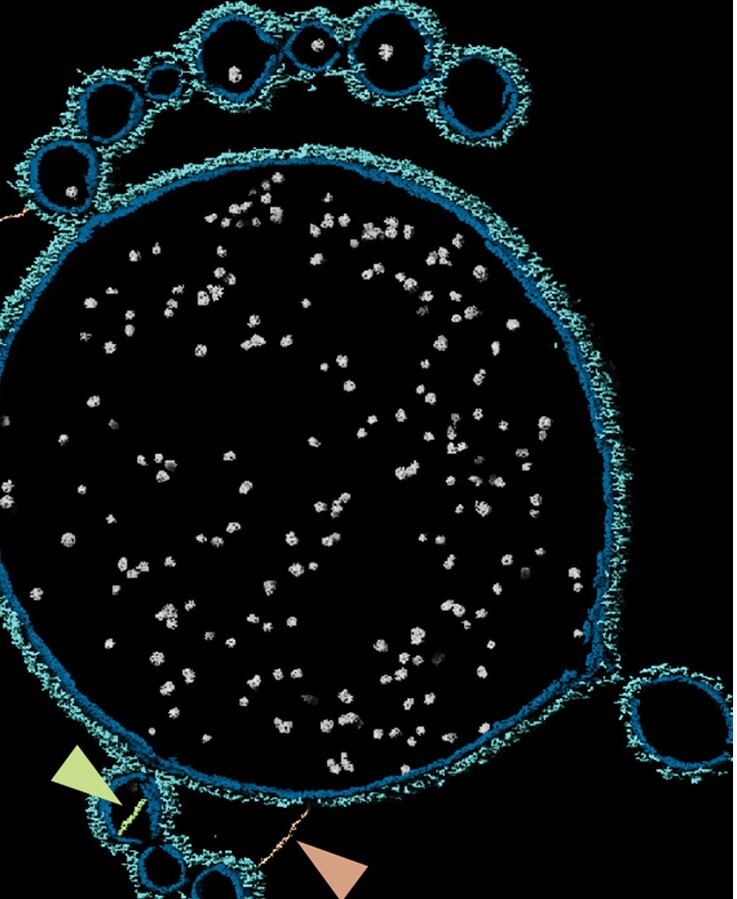
Cryo-EM also showed that N. marumarumayae interacted with a nearby bacterium, such as S. nilemahensis, a sulfur-reducing bacterium. The tubular fibers of the bacterium interacted with the N. marumarumayae cell and its extensions. Findings suggest that N. marumarumayae produces H₂ and formate, which are used as energy sources by S. nilemahensis. In turn, organic compounds produced by S. nilemahensis could be used by N. marumarumayae for fermentation and growth. Furthermore, the cellular extensions of both the Asgard archaeon and the bacterium support this syntrophic exchange.
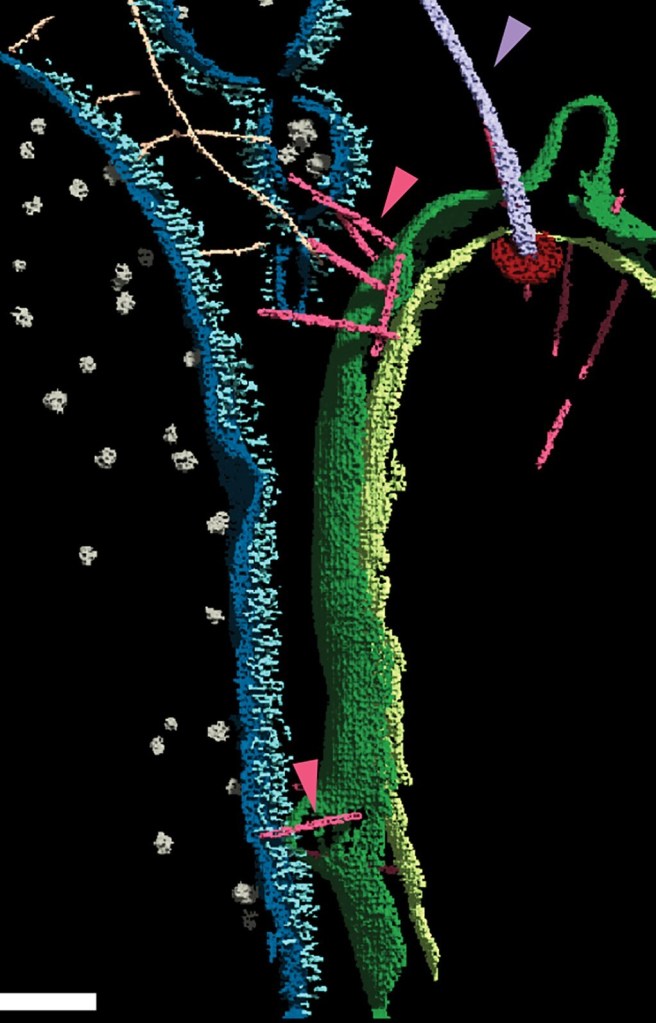
These pieces of visual evidence suggest that Asgard archaeal ancestors could have had a close and interdependent relationship with bacteria. Such a tightly knit syntrophic relationship might have eventually led to the engulfment of the bacterium and eukaryogenesis. These hypotheses should be further tested and experimentally validated in the future by cultivating more of these difficult-to-grow Asgard archaea. Similar to the mythological realm of Asgard, microbial mats have been described as a “microbial village that helped raise a eukaryote.” Therefore, It is also important to consider the dynamic environment of microbial mats and how it might have shaped the survival and evolution of such syntrophic relationships, which led to eukaryogenesis.
Link to the original post: An Asgard archaeon from a modern analog of ancient microbial mats. Stephanie-Jane Nobs, Matthew D. Johnson, Timothy J. Williams, Julia Meltzer, Xabier Va´ zquez-Campos, Fraser I. MacLeod, Keiran Rowell, Miranda Pitt, Bindusmita Paul, Doulin C. Shepherd, Katharine A. Michie, Iain G. Duggin, Debnath Ghosal, and Brendan P. Burns. Current Biology 36, 2090–2103, April 20, 2026 DOI: https://doi.org/10.1016/j.cub.2026.03.041
Featured image: https://doi.org/10.1016/j.cub.2026.03.041