
Breaking down the microbiology world one bite at a time
Bloody snow: an investigation
A bloody discovery
Spring is a very exciting time for me and my friends, because it means the start of the hiking season in the French Alpes. This year, the winter was long and snowy and we were perhaps a little over confident when we climbed up in the beginning of May, quite unprepared for the snowfields we would find. After 2 hours of walking uphill, we encountered the first snow. And to our horror, it was covered in blood… a lot of blood.
Or was it? At a second glance, we weren’t sure about the color, and we also wondered whether the area would have been open to hikers at all if an extremely bloody accident had occurred. Maybe someone just cut a lot of watermelons in this spot? Or maybe the color wasn’t caused by humans at all?
Back at home, I googled around and found no recent news about an extremely bloody accident in the Belledonne mountain range, but I did find this picture:
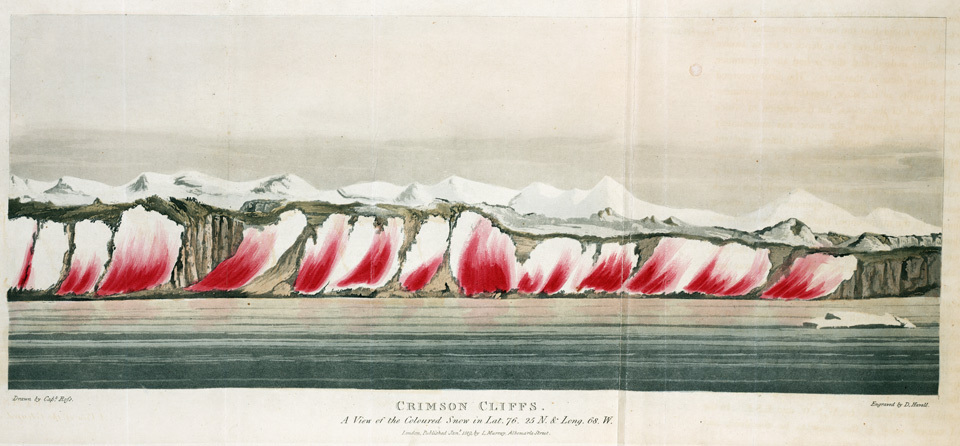
Apparently I was not the first person who came across this “crimson snow”. In 1818, the British explorer John Ross found some in Greenland and brought it back home. And when he asked scientists about the origin of the color, they told him it was caused by algae.
Mountainous microbes
Only very recently, in 2019, researchers found out which type of algae is the main producer of the red color and named it Sanguina nivaloides. In spring, these algae profit from the increased sun exposure to grow and bloom. To protect their photosynthetic machinery from being damaged, they produce pigments that color the snow a bloody (or watermelon colored) red. Mystery solved!
But for a microbiologist that is particularly fascinated by microbial communities, the search wasn’t over. I now knew about the origin of the red color, but a little bit of reading made me want to explore this fascinating snow-world more deeply. What other micro-organisms live in the snow? How do they interact with the red algae? And how do all these microbes survive in the extremely variable environment of the snowy mountains?
To my delight these questions and more were addressed in this recent paper. In the paper, the researchers investigated Phenoliferia psychrophenolica, a yeast species shown to reside in the presence of the red cysts produced by the S. nivaloides algae.
Red pigments
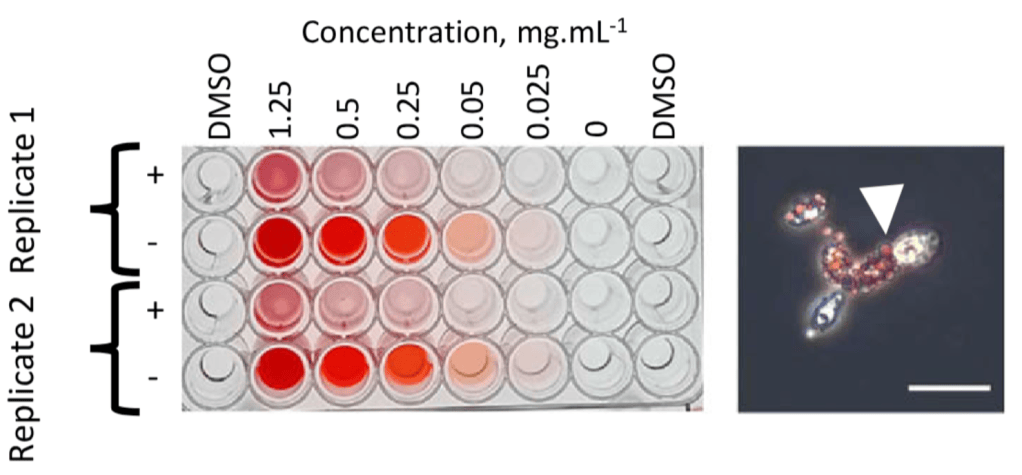
To investigate if and how P. psychrophenolica interacts with S. nivaloides, they grew the yeast in the presence of astanxanthin acyl ester, a pigment that is known to be excreted by the red algae. When P. psychrophenolica was added to a solution of pigment, the sample became less red over time, indicating that the pigment was broken down by the yeast.
Under the microscope, the researchers could observe an accumulation of astaxanthin acyl ester as red spherical particles on the surface or within the yeast cells.
Exploring the genome
P. psychrophenolica was found in various locations; the European Alps, the Arctic and the Antarctic. In these environments, the organism faces very cold temperatures and scarcity of water and nutrients. These harsh conditions are often followed by snow melts and algal blooms. To understand how it survives these variations, the researchers looked at the yeast’s genome. Comparing its genome with databases of known genes, they found that the organism contains around 500 genes that can help to break down different sugars and other complex organic molecules. This is more than previously found in similar yeast-species and gives P. psychrophenolica plenty of food choice in plenty of different situations. The organism was also found to contain a remarkably high number of ice-binding proteins that can prevent damaging ice-crystals from forming in their cells.
Snowy murder mystery
The findings of the paper show that the bloody red algae are not alone in the ecosystem. Their blooms allow other microbes to grow around them, such as snow yeasts. With their remarkable repertoire of genes these yeasts could be considered cleaners of edible molecules in snowfields. So if you were looking for a snowy murder mystery, you might be a little disappointed, but isn’t this newly discovered web of microbial interactions at least as thrilling?
Link to the original post: Ezzedine, J.A., Guenzi-Tiberi, P., Villain, G. et al. Snow- and ice-ecosystem cleaning capability of the pucciniomycotinous yeast Phenoliferia psychrophenolica. Commun Biol 8, 1084 (2025). https://doi.org/10.1038/s42003-025-08506-w
Featured image: Feature image: The Duel between Onegin and Lensky by Ilya Repin (1899)