
Breaking down the microbiology world one bite at a time
Biosurfactants to the Rescue!
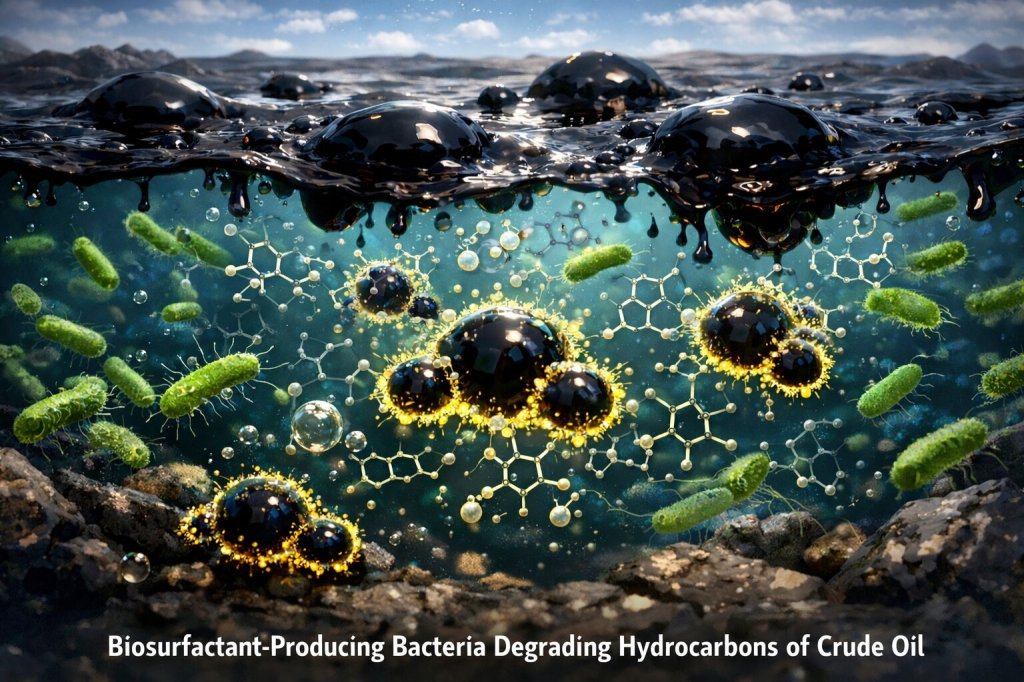
When thinking about the world’s primary energy source, the first name that comes to mind is petroleum. However, its usage is beyond transportation energy. Refined products from crude oil are used to create plastics, synthetic fibres, cosmetics, and medicines. Let’s refresh our memory, petroleum or crude oil is a non-renewable energy source. Over time, its use in industrial, infrastructural, and technological applications has caused severe environmental contamination, appearing as natural pollutants. The General Assembly of the UN has adopted this irreversible ecosystem damage as Sustainable Development Goals(SDGs); namely Life below Water (14) and Life on land (15). This makes us think about degradation processes. Our mighty warriors in this plight are microorganisms because some of them are capable of producing biosurfactants, biodegradable surface-active compounds. Researchers have demonstrated that biodegradation of crude oils using biosurfactants is possible. How? Biosurfactants can degrade the hydrocarbon structure of crude oils.
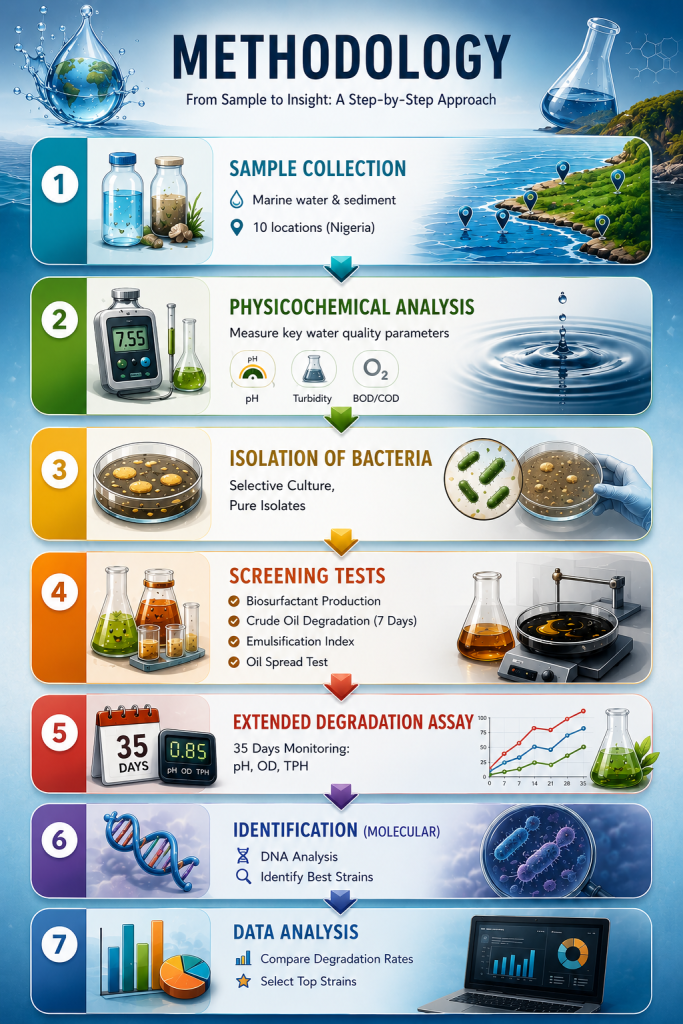
A study between August 2020 and August 2021 occurred, where researchers collected water and sediment samples from ten beaches, lagoons, and creeks across Lagos and Ondo States in Nigeria. According to the standard American Public Health Association (APHA)(1995), 19th edition, the researchers performed physicochemical analysis, including chemical oxygen demand(COD), biological oxygen demand(BOD), and heavy metals, to evaluate the parameters of the seawater and sediments within the permissible limits of the World Health Organization (WHO). After that, they transferred the measured samples to enrichment media and periodically transferred to achieve well-adapted crude oil-degrading bacteria from non-degraders. Additionally, they observed the selected isolates under the microscope and performed Gram staining and biochemical tests. This was done to establish which type of bacteria were commonly present in the marine ecosystem.
Afterwards, researchers screened for biosurfactant production using oil spread, drop-collapse, and emulsification index tests. In the oil spread test, biosurfactant production is measured by the clear zone formed after oil is displaced on the water surface. The drop-collapse test is a simple method for detecting biosurfactant production by observing whether a liquid droplet spreads or collapses on an oily surface. Meanwhile, in the emulsification test, biosurfactant activity is evaluated by measuring its ability to form or maintain a stable emulsion between oil and water. Out of the twenty isolates, fifteen were positive, indicating possible biosurfactant production. Following this, the team used 2,6-dichlorophenolindophenol(DCPIP) redox dye to screen positive biosurfactant-producing isolates for crude oil degradation by periodically monitoring the flasks. The DCPIP is used as a redox indicator to detect when the bacteria metabolize hydrocarbons and transfer electrons during oxidation-reduction reactions. The more reduction reaction, the more color shifts from blue to colorless. They used a UV-VIS spectrometer to measure the bacterial growth rate at specific intervals.
The researchers selected and further investigated seven high-potential isolates weekly for 35 days by bacterial growth(OD), changes in pH, biosurfactant concentration, OST[Oil Spread Test], emulsification test, and crude oil content[Total Petroleum Hydrocarbon(TPH)] to narrow down to the three most efficient biosurfactant producers. Based on the methodical approach, the team confirmed these three isolates, Escherichia sp.-MAK-S, P. aeruginosa-MID-W, and P. aeruginosa-OKO-S, for efficient biosurfactant production and crude oil degradation. It is important to note the naming of the isolates to understand which isolates came from which marine site. Here, MAK-S is a sediment sample from Makoko, MID-W is a water sample from Midlagoon, and OKO-S is a sediment sample from Okobaba.
For molecular characterization, the analysts extracted the genomic DNA using cetyltrimethylammonium bromide. The extracted DNA was used as a template for 16S rRNA PCR amplification. Lastly, they used Geneious version 9.0.5. by BLAST analysis to assemble the sequence. The sequence of Escherichia sp.-MAK-S was 99% similar to Escherichia hermannii strain K167, P. aeruginosa-MID-W was 97% similar to P. aeruginosa strain Sihong_820_11, and P. aeruginosa-OKO-S was 99% similar to P. aeruginosa strain P73. This agrees with previous reports that hydrocarbon-degrading bacteria isolated from the marine ecosystem mostly belong to the species of Pseudomonas, Escherichia, Micrococcus, and Acinetobacter.
After this lengthy process, it has been confirmed that bacteria isolated from marine ecosystems can produce biosurfactants, which in turn degrade the crude oil hydrocarbons. Although most physicochemical analysis parameters were within the WHO permissible limits, some exceeded them due to water pollution. Various factors, such as the human population, growing industries, and agricultural projects around the lagoons, have altered the hydrochemical and hydrobiological properties of the water bodies, along with the characterization of microbes.
Based on the results of this study, Pseudomonas spp. have a higher capacity for hydrocarbon degradation than other genera. This may be because Pseudomonas spp. can grow in simpler media and utilize many substrates, which may be toxic to other microbes.
Featured image: https://chatgpt.com/s/m_691b2d56a74c8191aa033f66bef6255e