
Breaking down the microbiology world one bite at a time
Toxoplasma gondii Parasites Do Not Just Hide in the Brain
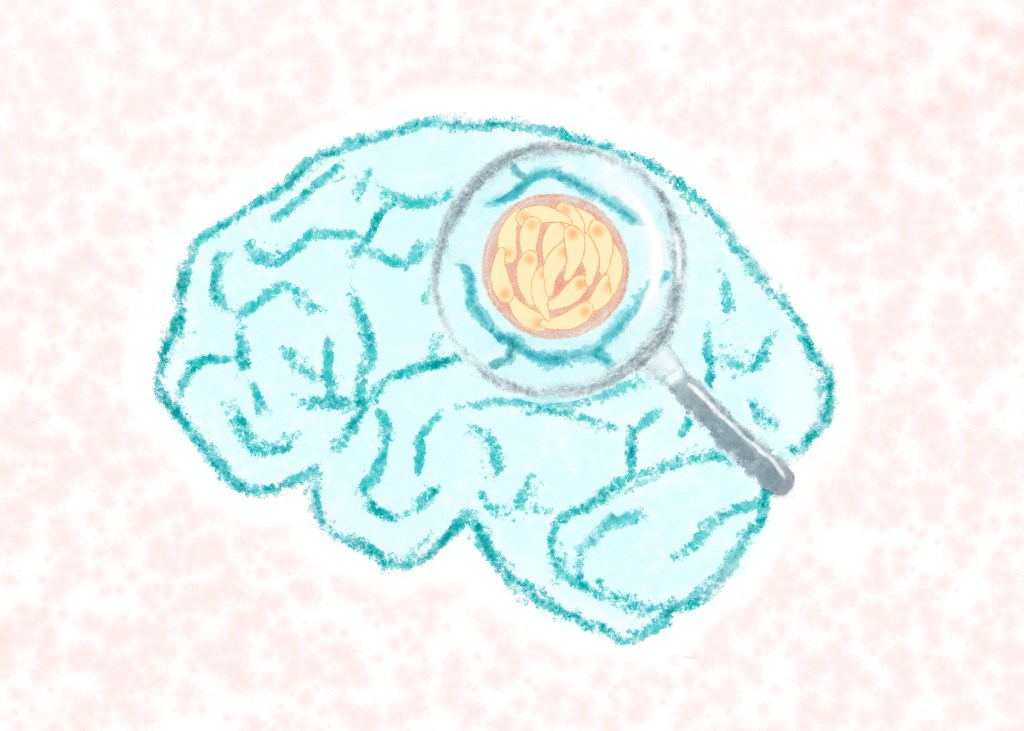
Was it the meat, or worse, the cat? Unfortunately, hundreds of Toxoplasma gondii parasites were found encysted together in your brain, waiting for the right time to awaken from latency. A few days earlier, they were roaming free in your body in the form of tachyzoites, invading and bursting cells one after the other while proliferating quickly. Luckily, your immune system swiftly curbed the acute infection. Yet it failed to stop parasites from retreating within your neurons or muscle cells.
There, beneath a thick cyst wall, tachyzoites morphed into slow-growing forms called bradyzoites, whose ability to reactivate puts you at risk of developing symptoms later in life. Contrary to popular belief, this reservoir of parasites is far from being dormant, and in no way fully sheltered from the host’s immune system. In a recent Nature Microbiology study, scientists discovered that the presence of brain cysts may help the immune system keep the host alive at the parasite’s advantage.
The first clues emerged from the brains of mice — which are natural hosts for Toxoplasma gondii — infected with parasites unable to form cysts. “We thought that if we could remove the latent forms, maybe the immune system would clear the infection, and the [host’s] resistance would be better,” said senior author Christopher Hunter, Professor at the University of Pennsylvania, School of Veterinary Medicine.
The results were quite different. Parasites lacking the key molecular switch Bradyzoite-Formation Deficient protein 1 (BFD1), allowing tachyzoites to transform into bradyzoites, led to a worse disease outcome. Compared to their natural counterparts, they multiplied more extensively in the mouse brain, causing tissue necrosis and inflammation so severe that the animal’s chances of survival decreased considerably.
“Essentially, the damage caused by tachyzoites’ replication accumulates,” Hunter said. “There’s no upside to it.”
To dissect what could lie behind such dramatic outcome, the scientists designed a framework combining computational predictions and in vivo observations. Building on previous mathematical models, they designed an environment in which both tachyzoites and bradyzoites could be the target of immunity. They then tweaked specific parameters to artificially reproduce infections, as they may unfold in real life.
“ It really just provides a tunable system where we could ask which variables are the most important to describe the natural kinetics that we see,” Hunter said.
For instance, removing immune pressure from the system allowed parasites to proliferate uncontrollably — a life-threatening reality for immunocompromised individuals. On the other hand, adding immunity back curbed the infection and any further reactivations. Yet when scientists removed bradyzoites from the equation, including their ability to reactivate, the immunity became less efficient, suggesting an important link between bradyzoites and host resistance.
“Latent or chronic infections maintain the immune system by continuous low-level stimulation,” Hunter said. “So, I think the cyst helps to do that.”
In mice, the excessive replication of parasites unable to form cysts led to an increased recruitment of leucocytes in the brain, compared with regular parasites. Yet it failed to protect the host long term. Among the myriad immune cells likely involved in the process, the team focused on CD8+T cells. They can kill infected cells on the spot and produce key immune mediators, like interferon gamma (IFNƔ), to alert neighboring cells to help restrict parasite proliferation.
To determine whether the absence of bradyzoites could affect how CD8+T cells operate, the team engineered parasites — either natural or lacking BFD1 — to produce a piece of a known protein called ovalbumin (OVA) at different stages of infection. They then injected mice with a small pool of CD8+T cells designed to proliferate exclusively after recognizing OVA in the mouse body.
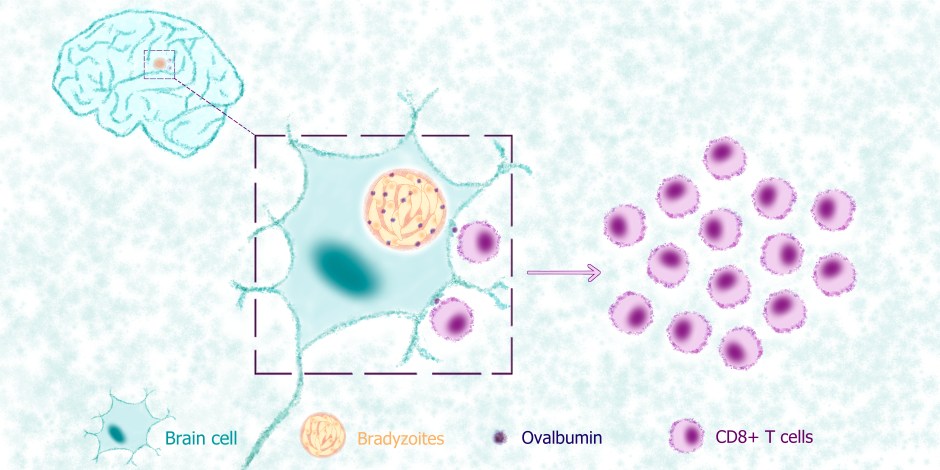
Consistent with previous findings, CD8+T cells successfully detected bradyzoite fragments tagged with OVA, when present in the brain. This interaction did not lead to a strong IFNƔ production, which may favor cyst persistence in neurons. Yet it helped establish a strong pool of memory CD8+T cells, known to provide long-term protection during chronic infection. In the absence of cysts, however, the number of memory cells decreased significantly, possibly setting the stage for uncontrolled parasite proliferation.
“In the brain, you really need to balance protective and pathological T cell response,” Hunter said. “I think there’s an interplay there where, maybe, because the infection is in neurons, it just results in a suboptimal T cell response.”
Altogether, these results add a new dimension to Toxoplasma gondii complex life cycle, where the immune response to latent parasites shapes the very characteristic features of the disease. Yet much work is needed to understand how cyst-containing bradyzoites can persist so long in the brain, and how we can successfully target them. Indeed, no cures are available to eliminate latent parasites, and with a third of the world’s population estimated to be infected, the impact on public health may be overlooked.
According to Hunter, this study reminds us that parasites “are not just passive passengers.” They finely interact with the host cells — be they the ones they infect or those that come to the host’s rescue — tilting the balance between persistence and elimination. And to all appearances, this tacit agreement ensures the survival of all parties.
Written by Laura Mac-Daniel
Link to the original post: Eberhard, J.N., Shallberg, L.A., Winn, A. et al. Immune targeting and host-protective effects of the latent stage of Toxoplasma gondii. Nat Microbiol 10, 992–1005 (2025).
Featured image: Toxoplasma gondii parasites form cysts in the brain. Credit: Laura Mac-Daniel