
Breaking down the microbiology world one bite at a time
An ancient anti-viral defense system
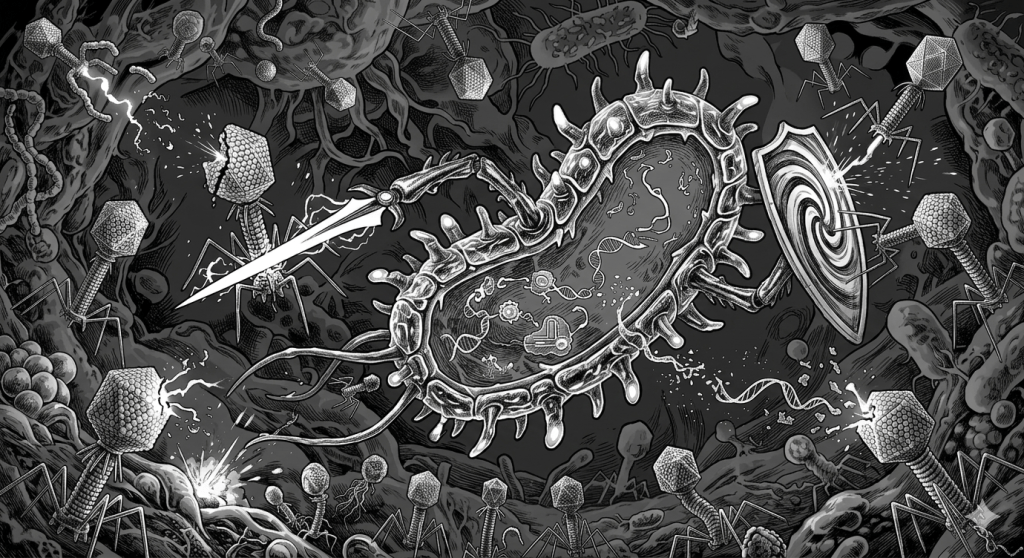
All cells from bacteria to humans are under continuous attack by various attackers. Over millions of years, they have developed mechanisms to defend themselves from these attacks in several ways. Bacteria faced these challenges millions of years ago and survived by developing systems which have been conserved during evolution and most modern forms of life have repurposed them for their advantage. One of the common threats among humans and bacteria are viruses which attack their host cells and use the host machinery to produce more of them and often kill the host in the process. A known mechanism of anti-viral defense in human cells is cleaving of the tRNA and rRNA (RNAs required for protein synthesis in cells) mainly used by viruses for replication. This is carried out by some members of a group of proteins known as Schlafen proteins (Slfn) in mammals. Part of this protein is highly conserved and is an RNA endonuclease (RNA cutting protein), which is used as a tRNA/rRNA cleaving machine.
How did the search begin?
There were systems previously known in bacteria which use similar mechanisms. But there was no direct evidence that Slfn-like systems exist in bacteria. To find out the Slfn-like system, researchers used the human Slfn protein sequence as a reference and identified 5,930 unique protein sequences in archaea and bacteria (procaryotes). Out of these 5,930 sequences 69.6 % of sequences were present near other defense genes in the bacterial genomes while the rest were present in non-defense gene clusters, hinting at functions other than anti-phage defense. In ~97% cases the Prokaryotic Slfn (pSlfn) were fused with other proteins, few of these fused proteins had an immunoglobulin (ig) like fold (widely found in antibodies), possibly to identify specific phage (a virus that infect bacteria) signatures in bacteria.
Bacteria use immunoglobulin like folds for phage recognition
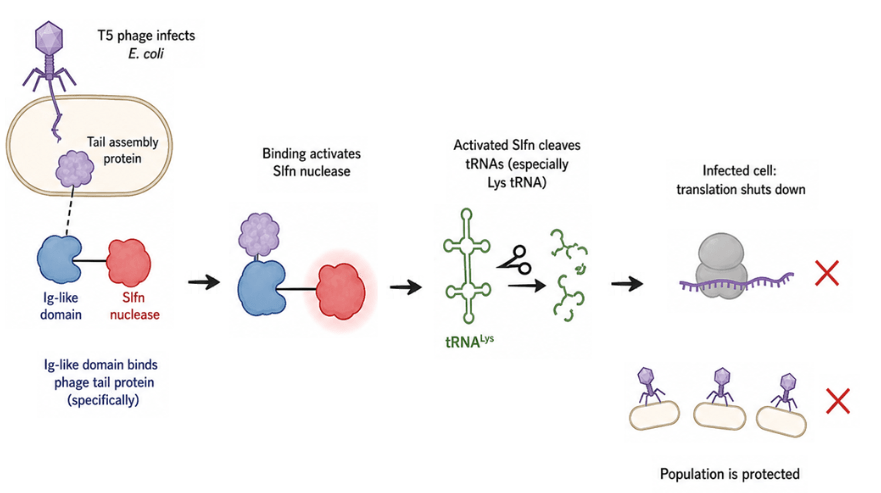
Researchers used one such pSlfn-ig fused system from bacteria Raoultella ornithinolytica and expressed it in the common E. coli cells used in laboratory. They found out that this system protected E. coli cells specifically from a T5 phage (a type of phage which infects E. coli cells), but not from other types of phages. DNA sequencing of these phages which escaped this defense system, revealed that the genes required for phage tail formation were mutated. The pSlfn-ig system might be recognizing proteins encoded from these genes and hence mutations in them caused failure in recognition. Replacing the ig domain from the Raoultella Slfn system into another bacteria Serratia fonticola Slfn system could show protection from T5 phage in E. coli. Indicating the role of ig domain in specific recognition of phages by bacteria.
How does it work?
The next question was how exactly this system protects bacteria from phages. Researchers saw that RNA was found cleaved isolated from E.coli cells expressing the Raoultella Slfn system and triggered by phage tail forming protein. Sequencing of total RNA from these cells showed that the cleavage was occurring mainly in the tRNAs (RNAs required in protein synthesis). These tRNAs included both bacterial and phage tRNAs. Reactions performed in test tubes outside bacteria showed that Raoultella Slfn protein along with phage tail forming protein was required for cleaving the tRNAs. Proving that this system protects bacteria from phages by cutting down tRNAs. Shutting protein synthesis prevents phages from dividing and hence controls their population.
The anti-viral defense mechanism in bacteria utilizes the specificity of recognition of a specific type of phage and shows response accordingly. This ig fold later adapted to higher organisms such as vertebrates in the form of antibody-mediated immunity. Also, Schlafen proteins remain functional for the similar anti-viral system in mammalian cells.
Modified from the image generated by ChatGPT
Link to the original post: Perez Taboada, V., Wu, Y., Cassidy, R. et al. Bacterial Schlafen proteins mediate phage defence. Nat Microbiol 11, 1037–1048 (2026). https://doi.org/10.1038/s41564-026-02277-8
Featured image: Generated by the author on gemini