
Breaking down the microbiology world one bite at a time
Socializing promotes gut microbe diversity in babies
Few moments feel as nerve-racking for parents as that first day at daycare. You hand your child over to a room full of unfamiliar faces and you wonder: Will they get along? Will they play nicely together? Will they learn to share?
It turns out, they are!
Long before toddlers negotiate over toy trucks and building blocks, babies start exchanging something less visible to the eye: microbes. The sharing may be unconscious, but the consequences are real. By receiving and transferring microbes, the gut microbiome evolves and matures into a diverse, healthy system.
To capture how this micro-exchange unfolds, researchers at the University of Trento in Italy set up the ‘microTOUCH-baby’ project. For this project, they followed 43 babies through their first year in nursery, tracking their gut microbes, and those of their family members and caregivers. The results are clear: early social life shapes the ecosystems within us.
First colonizers
Much has been written about the very first settlers of the infant gut. From the moment of birth, a baby’s microbiome begins to take shape, with different factors determining which microbes move in first: Was the baby born vaginally or by C-section? Prematurely or at term? Breastfed or formula-fed? Even the mother’s diet leaves a trace.
As infants grow, new transitions follow. The introduction of solid foods reshapes the gut, and close contact with parents and siblings further influences which microbes thrive. These early, family-driven exchanges have been studied well before. However, how further social interactions, for instance with peers, affect the microbiome, hasn’t been well established. Enter the micro-TOUCH Baby Study!
Sharing is caring
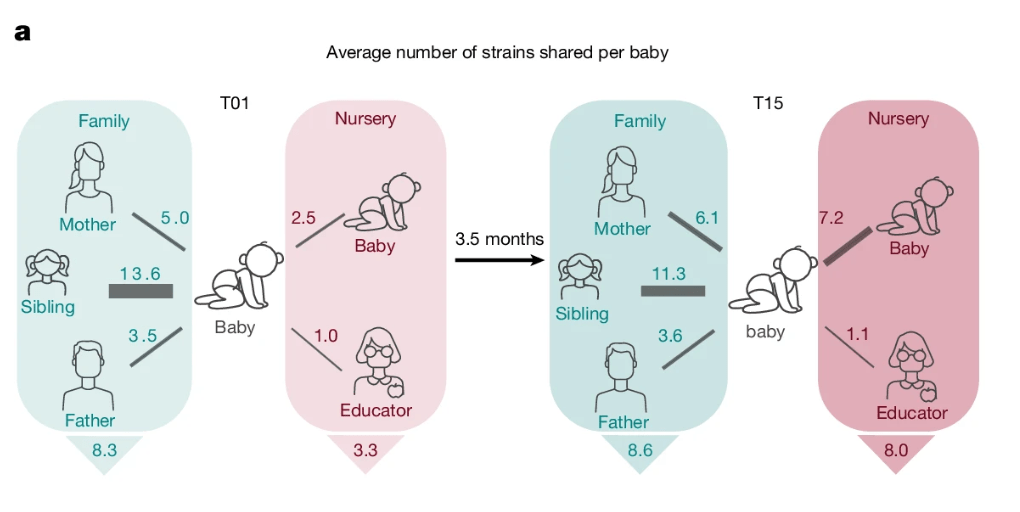
After just three months in daycare, the impact of social life was already visible in the gut (see Figure below). The infants’ microbiomes had grown more diverse, enriched by new microbial arrivals that migrated from other babies. Simply being in close contact, crawling on the same mats, grabbing the same toys, sharing the same air, was enough to reshape their internal ecosystems.
The longer the children spent in daycare, the more pronounced the shift became. After a year in the nursery, roughly 17% of the infants’ microbes could be traced back to peers, whereas 15% came from family members at home. The nursery had become just as influential as the household! Intriguingly, babies with siblings appeared to acquire fewer new microbes from peers at daycare than only children. One possible explanation is that their microbial “starter kit” is already more diverse. With many ecological niches in the gut already occupied, there may be less room for newcomers to establish themselves – a kind of microbial saturation point.
Within families, there was a stronger influence of siblings than of mothers and fathers. This is less surprising than it sounds: siblings do not only share genes, but also daily routines, social activities, and development stages. Their bodies and their worlds are simply more alike.
Easy come, easy go
During the summer holidays, daycare rooms fell quiet and babies spent more time at home with their families. As playdates with peers decreased and family contact increased, the community of microbes in their intestines subtly rearranged, favoring microbes from their family members. In adults, a similar change in surroundings would rarely leave such a visible mark on the gut, but in babies, the microbiome is still wide open to influence.
This flexibility became even more striking when antibiotics entered the picture. A course of antibiotics swept through the infant gut dramatically, yet the calm returned quickly. Almost as soon as bacteria were wiped out, new microbial settlers began to arrive and establish themselves. Babies, it seems, are both more vulnerable, and more resilient, than we might expect.
Overall, the infant gut is less of a fixed, and more like a rapidly evolving ecosystem. Shaped not only by family, environment, and diet, it is also influenced by peers from the very start of social life. Whether the microbial traces of these earliest social encounters still linger decades later remains to be seen.
Link to the original post: Ricci, L., Heidrich, V., Punčochář, M. et al. Baby-to-baby strain transmission shapes the developing gut microbiome. Nature (2026).
Additional source: Milani, C., Duranti, S., Bottacini, F. et al. The First Microbial Colonizers of the Human Gut: Composition, Activities, and Health Implications of the Infant Gut Microbiota. Micobiol Mol Biol Rev (2017).
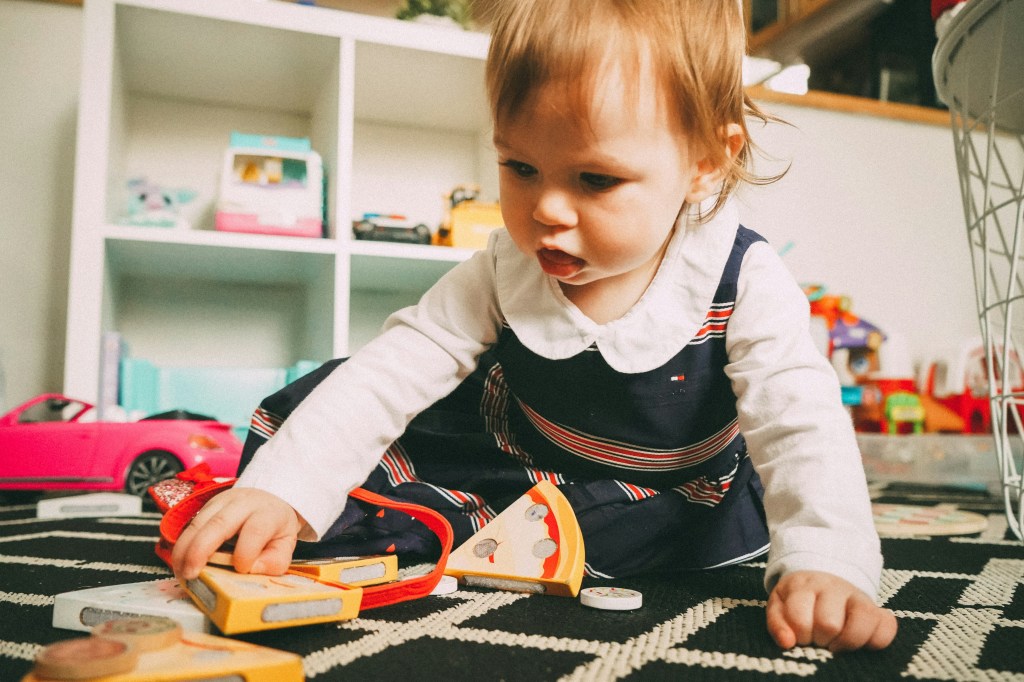
Featured image: Image from Troy T, unsplash