
Breaking down the microbiology world one bite at a time
Plastic to Paracetamol: Manufactured by E. coli
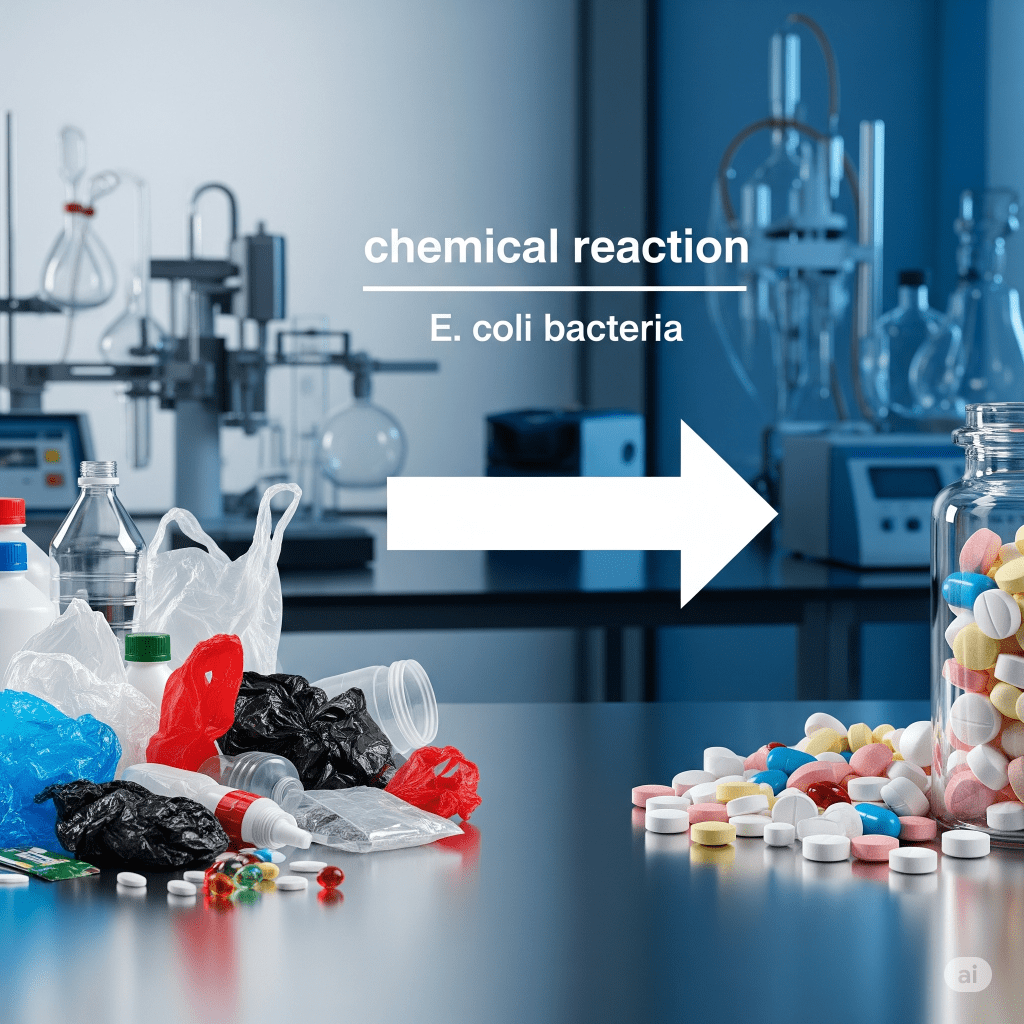
Paracetamol, one of the most widely used painkillers, is typically produced from petroleum. As this process depends on fossil fuels, it contributes to environmental pollution. The traditional synthesis of paracetamol involves a multi-step chemical process starting from phenol: it includes nitration to form nitrophenol, reduction to aminophenol, and finally acetylation to produce paracetamol. While effective, this process requires hazardous reagents and precise control of reaction conditions, making it a chemically intensive process. However, researchers have discovered a novel biocompatible chemical reaction that can revolutionize how we produce this essential medicine while also addressing the concern of plastic waste. This innovative method combines chemical reactions with bacterial metabolism to transform polyethylene terephthalate (PET) plastic into valuable chemical compounds, including paracetamol.

Image Source: Figure created by the author using CanvaPro.
Bridging chemistry and biology
Nature has evolved a limited set of chemical reactions that sustain life, but synthetic organic chemistry offers a broader range of reactivity not found in nature. By integrating these so-called ‘abiotic reactions’ into living systems, scientists can sustainably produce industrial chemicals. The current study focuses on the Lossen rearrangement, an abiotic chemical reaction that converts specific compounds into primary amines. This reaction, traditionally used in synthetic organic chemistry, has now been adapted to function within the bacterium Escherichia coli (E. coli).

Image Source: Johnson et al. (2025)
Engineering microbial metabolism
The researchers aimed to demonstrate that the Lossen rearrangement could be biocompatible and integrated with microbial metabolism. To achieve this, they designed an experiment using a specific strain of E. coli that was deficient in para-aminobenzoic acid (PABA), an essential metabolite required for folate biosynthesis. PABA is crucial for the synthesis of folic acid, which in turn is necessary for nucleotide and DNA synthesis in bacteria. The absence of PABA in the bacterial strain meant that the bacteria could not grow unless PABA was supplied or produced directly within the bacterial cells.
To test the biocompatibility of the Lossen rearrangement, the researchers introduced a substrate derived from PET, a common plastic, into the bacterial culture. PET was first hydrolyzed to terephthalic acid, which was then chemically modified to form the Lossen rearrangement substrate. If this substrate underwent the Lossen rearrangement to produce PABA, the successful production of PABA would enable the growth of the PABA-deficient E. coli, thereby proving the compatibility and effectiveness of the reaction within a living microbial system.
A new pathway for plastic upcycling
The reaction was non-toxic to E. coli and worked under normal conditions, showing that the Lossen rearrangement could happen inside living cells without harming them. The researchers successfully grew E. coli strains lacking PABA by introducing the Lossen rearrangement substrate, confirming that the reaction could produce essential metabolites in living organisms.
The team demonstrated that PET-derived substrates could support microbial growth and metabolism. This suggests a potential method for bioremediating plastic waste and converting it into valuable chemical compounds. By integrating the Lossen rearrangement with engineered metabolic pathways, the researchers produced paracetamol from PET-derived substrates. This process involved converting PABA into 4-aminophenol and then into paracetamol using specific enzymes. The entire process, from PET to paracetamol, could be completed in less than 24 hours. This is significantly faster and less resource-intensive than the conventional chemical synthesis of paracetamol.
A sustainable future
By showing that a non-enzymatic chemical reaction can be integrated with microbial metabolism, the researchers have opened new avenues for sustainable chemical synthesis of important compounds. The ability to convert plastic waste into valuable chemicals and medicines not only addresses environmental pollution but also reduces reliance on fossil fuels for chemical production.
Link to the original post: Johnson, N.W., Valenzuela-Ortega, M., Thorpe, T.W. et al. A biocompatible Lossen rearrangement in Escherichia coli. Nat. Chem. 17, 1020–1026 (June 2025).
Featured image: Google Gemini