
Breaking down the microbiology world one bite at a time
Beating the Heat: How the Fungus Live Among Us
Despite the prevalence of fungal diseases in plants, insects, and amphibians, fungi pathogenic to mammals are incredibly rare. In fact, fungi did not emerge as major human pathogens until the introduction of antibiotics (causing disrupted microbiomes) and the development of immunosuppressive therapies. In mammals with balanced microbiomes and intact immune systems, resistance to fungal infections stems from their endothermy, the ability to maintain an internal body temperature.1
The major limitation of human infection for pathogenic fungi is body temperature. While most fungal strains grow well in temperatures ranging from 12°C to 30°C, their tolerance of heat rapidly declines at temperatures greater than 35°C. Since normal human body temperature averages at 37°C, and fevers, one of the immune system’s first responses to most infections, range from 38°C to 41°C, most fungi cannot survive in humans.1
For most microbes, temperatures of 37°C or higher act as a heat stress signal.2 Heat stress can stimulate the production of reactive oxygen species (ROS). Unregulated, these molecules can cause severe damage to mitochondrial proteins and the mitochondrial membrane; they can also induce mutations in mitochondrial DNA. This damage can then lead to the activation of cell death pathways.3
To survive in humans, pathogenic fungi must have adaptations to heat stress, such as altering the structure of their cell membrane and producing heat-resistant protective substances to combat against protein destruction.2 Researching these heat resistance mechanisms could not only potentially help with preventing or controlling fungal infections, but it could also provide an understanding of the evolutionary process of environmental fungi transforming into pathogenic fungi.
Three fungal species in particular are emerging human pathogens: Candida auris (Cau), Candida haemulonii var. vulnera (Chv), and Candida duobushaemulonii (Cdb). Cau is a growing global public health threat; with the ability to survive and grow at temperatures up to 47°C, it is easily able to overcome the host’s immune response of fever. Chv and Cdb are closely related to Cau, and the incidence of infections of these three fungi has been increasing worldwide. In addition, all three species are often resistant to multiple antifungal agents, making them difficult to treat.
In this study, Xiao and their team looked to characterize the heat resistance mechanisms of Cau, Chv, and Cdb strains taken from blood samples of hospitalized patients and to propose how these strains “beat the heat” of human body temperature. They proposed that each strain had a distinct method for combating heat stress.
In response to heat stress, all three strains increase glucose uptake and attempt to accumulate pyruvate. Pyruvate, which is made from glucose through the process of glycolysis, can scavenge for ROS, stabilizing the mitochondrial membrane and reducing protein destruction. To accumulate pyruvate, Cau and Chv both work to increase pyruvate synthesis. Cau prioritizes increasing the uptake of iron, which plays a key role in pyruvate synthesis and suppressing the production of ROS. Chv, on the other hand, increases the production of enzymes involved in sugar fermentation and hydrolysis, which make pyruvate.
Cbd does not increase pyruvate synthesis; instead, pyruvate accumulation in Cbd seems to primarily be achieved by preventing consumption of pyruvate by the cell. All three strains reduce pyruvate consumption, but they do so using unique enzymes. Cau decreases the production of the enzyme pyruvate decarboxylase, Chv reduces pyruvate dehydrogenase, and Cdb reduces both acetolactate synthase and pyruvate carboxylase.
Overall, these three fungal strains reduce heat-induced ROS by accumulating pyruvate, whether by increasing pyruvate synthesis, decreasing pyruvate consumption, or both (Figure 1).

To successfully infect humans, pathogenic fungi must be able to handle both normal and fever temperatures of the body. Established pathogenic fungi like Aspergillus fumigatus, Candida albicans, and Cryptococcus neoformans have been investigated for their heat resistance mechanisms, but there has been a notable increase in fungal heat adaptations and fungal infections. Research suggests climate change has had a key role in this increase.4
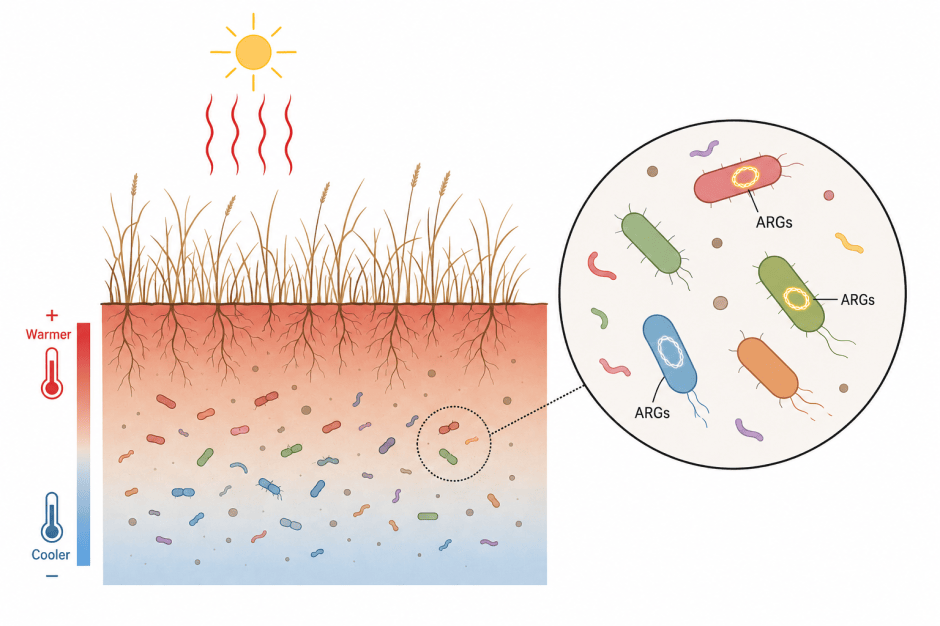
Climate change has been influencing fungal growth, distribution, and virulence. Precipitation changes and extreme weather events may be expanding the geographical range of pathogenic fungi by further dispersing their spores; in addition, the gradual increase of temperatures may lead to the evolution of fungal heat resistance mechanisms. Heat stress can also promote antifungal resistance, further increasing the threat of these emerging fungal strains.4
To properly control the growing danger of emerging pathogenic fungi like Cau, Chv, and Cdb, the methods underlying their heat adaptation must be understood. With individual strategies to survive the heat of a human body, each strain can potentially be prevented or treated by targeting these unique mechanisms. Thus, the very adaptations that allowed them to infect humans can be used to turn up the heat against them.
Additional sources:
George ME, Gaitor TT, Cluck DB, Henao-Martínez AF, Sells NR, Chastain DB. The impact of climate change on the epidemiology of fungal infections: implications for diagnosis, treatment, and public health strategies. Ther Adv Infect Dis. 2025 Feb 11;12:20499361251313841. https://doi.org/10.1177/20499361251313841
Robert VA, Casadevall A. Vertebrate endothermy restricts most fungi as potential pathogens. J Infect Dis. 2009 Nov 15;200(10):1623-6. https://doi.org/10.1086/644642.
Samtani H, Unni G, Khurana P. Microbial mechanisms of heat sensing. Indian J Microbiol. 2022 Mar 3;62(2):175-186. https://doi.org/10.1007/s12088-022-01009-w.
Slimen IB, Najar T, Graham A, Dabbebi H, Mrad MB, Abdrabbah M. Reactive oxygen species, heat stress and oxidative-induced mitochondrial damage. A review. Int J Hyperth. 2014 Oct 30;30(7):513-523. https://doi.org/10.3109/02656736.2014.971446.
Featured image: