
Breaking down the microbiology world one bite at a time
Searching the genome of lactic acid bacteria for compounds relevant for human health
This post is written by guest author Sara Rodrigues Pita
We all have a microbiome – a collection of microorganisms that live on or within us – spanning numerous sites on our body (e.g., gut, skin, vagina). Human microbiome-dwelling bacteria produce a range of metabolites which can be seen as an exchange of messages between a human host and its microbiome. The messages sent may involve mutualistic and/or antagonistic interactions amongst the bacteria. The source of microbiome-to-host messages is often secondary metabolites – compounds produced by an organism not directly essential for the organism’s survival but often confer the producing organism a competitive edge. A prime example of secondary metabolites are antibiotics. Antibiotics are compounds produced by bacteria that inhibit the growth of other bacteria, or even kill them. As such, antibiotic production can be seen as an adaptation strategy.
Lactic acid- producing bacteria, referred to as lactic acid bacteria (LAB), generate lactic acid through fermentation – a process in which carbohydrates are broken down. LAB have garnered interest within the scientific community due to their health-conferring abilities, which include immune system modulation, gut health improvement and pathogen elimination. Despite LABs known protective role in human health, how they execute said role remains a mystery.
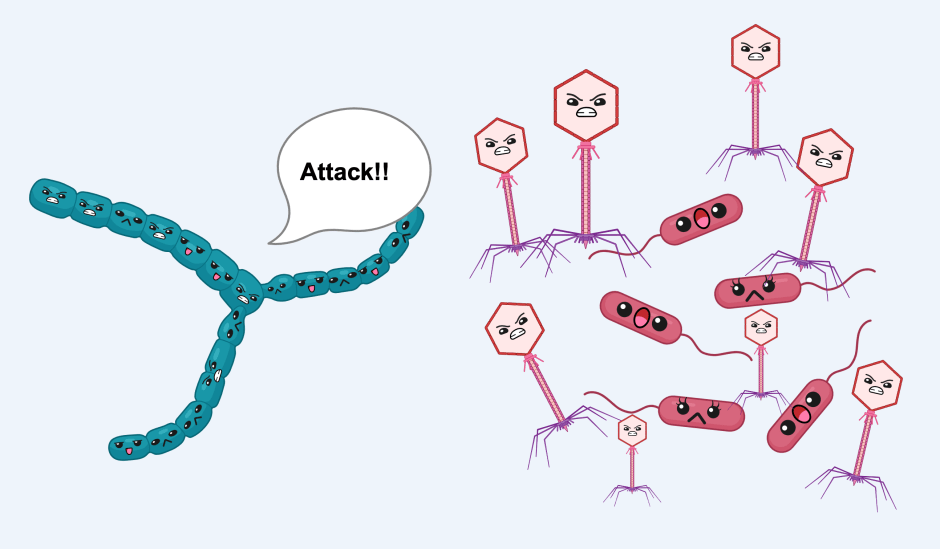
LABs are an integral part of the human microbiome and produce a wide range of secondary metabolites, of which bacteriocins are particularly of interest. Bacteriocins possess antimicrobial properties towards closely related strains and such antimicrobial properties are important in shaping microbial communities.
Distribution of metabolites produced by LAB
In an aim to characterize the landscape and distribution of secondary metabolites across LAB, a recent study from the University of Hong Kong conducted a first-ever large-scale analysis of the genomes – the complete set of genetic material – of an impressive 32,000 LAB. They scanned the genetic material for genes. Genes are inherited fragments of genetic material, many which contain the instructions for the assembly of molecules. In bacteria, the core genes involved in the production of secondary metabolites are often known and found in adjacent genetic fragments, termed gene clusters. Hence, the characterization of potential secondary metabolites produced by a bacterium requires pinpointing said gene clusters within its genetic material. Around 103,000 gene clusters responsible for secondary metabolite production were identified, of which 56% of these clusters corresponded to bacteriocins. Given that a bit over half of all secondary metabolites within LAB are bacteriocins, antagonizing other microbial members seems to be a prevalent role of LAB within the communities they inhabit.

As distinct gene clusters may lead to the production of compounds with overlapping roles, the scientists proceeded to score and group similar secondary metabolite gene clusters into gene cluster families. Gene cluster families (GCFs) contain the instructions needed for the production of very similar secondary metabolites with overlapping or highly similar functions.
The 103,000 secondary metabolite gene clusters were collapsed into 2,849 gene cluster families (GCFs). This means LAB can potentially produce 2,849 compounds with distinct functions and thus, biological activities.
When they looked at how these gene clusters are distributed among different bacteria, they found some interesting patterns. 76% of these GCFs were only found in one bacterial species. Furthermore, 41% of GCFs were only found amongst subgroups of a species, called strains. Evolutionary theory dictates genes shared amongst species are involved in basic biological processes. On the other hand, genes that are unique to a particular species or strain are likely involved in adapting to specific environments or making the bacteria more successful in their hosts. Since a majority of the secondary metabolite gene clusters were exclusive to a single species, it suggests that these gene clusters give those bacteria an advantage over others.
Additionally, GCFs that were species-specific were also more likely to be site-specific. This means GCFs are more likely to be produced by one bacterium within a specific site in the human body. A reflection of perhaps the role of LAB-derived secondary metabolites in the environmental adaptation strategy of LAB.
LAB metabolites within the human microbiome
Next, the scientists tried to assess the landscape of secondary metabolite gene clusters within LAB using 748 human microbiomes across 6 body sites. 5,687 secondary metabolite gene clusters that collapsed into 610 GCFs were identified. The oral microbiome had the highest number of GCFs. In spite of the vaginal microbiome having less than half of the GCFs than those found in the oral microbiome, the abundance of vaginal GCFs was the highest. This highlights the greater importance of LAB GCFs for the vaginal microbiome community dynamics compared to the microbiome of other sites in our body.

Noting the diversity and abundance of secondary metabolite gene clusters in LAB, machine learning was applied to pinpoint the functions of these clusters within the human microbiome. Results showcased that an astonishing 95.2% of these gene clusters were antibacterial; 1.8% led to cell death, 0.1% were both antibacterial and antifungal; 2% were antibacterial and led to cell death and finally, 1.1% had unknown functions. This supports the notion that most of the LAB-derived secondary metabolite gene clusters primarily play a role in excluding other bacteria. This enables LAB to outcompete other bacteria, whilst simultaneously modulating the microbiome’s bacterial composition.
After the observation that the vaginal microbiome was particularly enriched for bacteriocins and had fewer community members compared to other microbiomes, the scientists focused on testing whether LAB-derived secondary metabolites had antibacterial activity.
They found nearly all bacteriocin-type secondary metabolite gene clusters were associated with the absence of Lactobacillus iners (a bacterium previously linked to vaginal bacterial infection) and a reduction of overall microbial diversity in the vaginal mircobiome. Additionally, two types of LAB-derived bacteriocins (denominated crispacin 467 and 468) of LAB bacteriocins were produced and tested for antagonistic activity towards a range of bacterial strains. Crispacin 467 antagonized 3 bacterial species. As such, bacteriocin producers have a range of antagonistic properties that help protect the vaginal microbiome from pathogen invasion and thus, shape its bacterial composition.
All in all, this study suggests that part of LAB’s well-known health-promoting effects are tied to the production of a diverse set of secondary metabolites with antibacterial properties. Bacteriocins are particularly relevant and abundant secondary metabolites in LAB. They aid LAB in outcompeting pathogens and as a consequence, help shape the microbiome. This was exemplified with a vaginally dwelling bacteriocin, crispacin 467, which antagonized 3 other species common to the vaginal microbiome. LAB offer a rich and diverse set of bacteriocins that should be explored for future drug development efforts.
Link to the original post: Zhang, D., Zhang, J., Kalimuthu, S. et al. A systematically biosynthetic investigation of lactic acid bacteria reveals diverse antagonistic bacteriocins that potentially shape the human microbiome. Microbiome 11, 91 (2023). https://doi.org/10.1186/s40168-023-01540-y
Featured image: Created with BioRender























































 micro-bites.org