Breaking down the microbiology world one bite at a time
Probiotics Reshape Metabolism in Gut Microbial Community
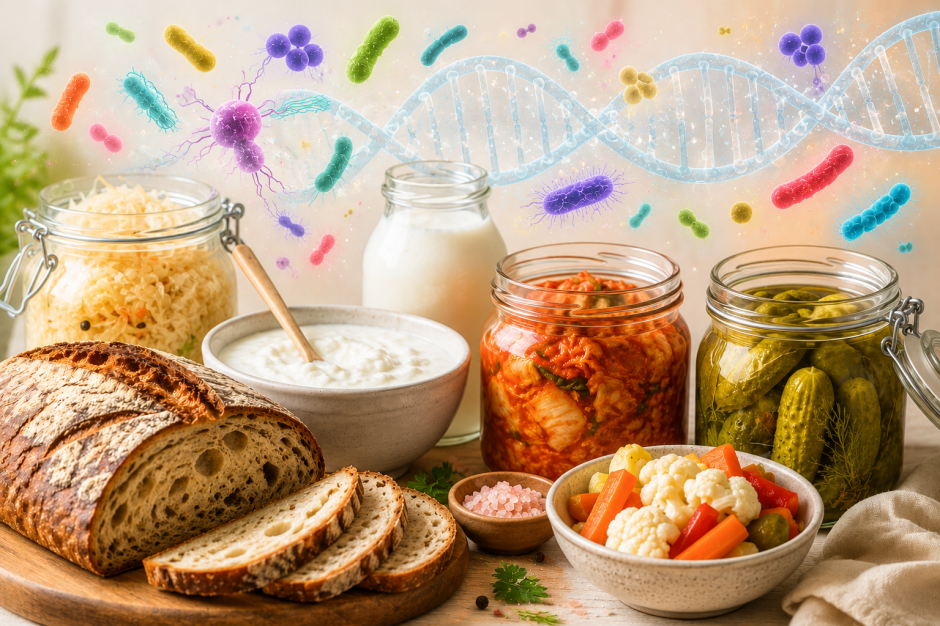
A bowl of yoghurt for breakfast, sauerkraut for dinner, and in between some glasses of kombucha: fermented foods are popular. Not only because they are tasty, but also because of their so-called probiotic effect. But to what extent do they actually help? Are they just hype?
Feel good microbes
Probiotics are defined as “live microorganisms that, when administered in adequate amounts, confer a health benefit on the host”. In short: microbes that can make you feel better!
Of course, it is a little bit more complicated than that. When you eat yoghurt, for example, do the microbes improve your gut health? Or do the compounds present in yoghurt have a positive effect? Or maybe it is a combination of compounds and microbes?
Most of the time, when the efficacy of probiotics is studied, mouse models are used, or small clinical trials are conducted. The problem with such studies is that it is hard to untangle the effects of compounds and microbes, and to understand exactly what is happening and why the probiotic has the effect that it does.
Less is more
To solve this problem, some researchers use synthetic microbial communities: subsets of microbes representing a certain microbiome that are well-defined and studied in a controlled environment.
By reducing the number of variables, synthetic microbial communities make it easier to understand what is going on: sometimes, studying a less complex system helps to gain a more complete understanding.
Diversity matters
In this study, researchers designed a synthetic microbial community representative of the microbiome in the small intestine. It consisted of the microbes P. fluorescens, E. coli and S. salivarius. They grew this community together with two different potential probiotics: S. thermophilus and L. casei. In addition, they studied the effect of adding an extra compound, in this case kynurenine.
Increased kynurenine metabolism could be beneficial to human health, since the final product of this pathway, kynurenic acid, has been associated with reduced inflammation and brain damage.
The study found that L. casei had a beneficial effect. When the community was supplemented with L. casei as well as additional kynurenine, the kynurenine pathway was stimulated more than in the control cases. The research suggested that this was thanks to the fact that L. casei was different from the existing community. It could consume and produce compounds that the other microbes could not. This made the community more diverse and helped to stimulate the kynurenine pathway.
In the setting of the small intestine, such diversity could help protect against pathogens since the probiotic microbes could consume compounds that would otherwise be consumed by harmful bacteria. This study therefore suggests that microbes that make the existing microbiome more diverse are promising targets for probiotic development.

‘
From marketing to science
The rather broad definition of probiotic as a “live, beneficial microorganism” has prompted many marketing initiatives that promise an easy gut fix. But a lot of questions are still unanswered: which microbes have a probiotic effect, for how long, and why? Studies like this one provide the start of an answer and a way to design probiotic therapies based on a mechanistic understanding of microbial interactions.
Link to the original post: Jansma, J., Chatziioannou, A.C., Castricum, K., van Hemert, S., El Aidy, S. Metabolic network construction reveals probiotic-specific alterations in the metabolic activity of a synthetic small intestinal community. mSystems 8 (2023) e00332-23. https://doi.org/10.1128/msystems.00332-23
Featured image: Flickr