
Breaking down the microbiology world one bite at a time
Can Leishmania Stand the Heat?
Leishmaniasis is a neglected tropical disease caused by an intracellular parasite known as Leishmania. The protozoan is spread by the bite of infected sandflies. There are numerous species of Leishmania and as a result different manifestations of leishmaniasis can develop. One of these forms is known as anthroponotic cutaneous leishmaniasis (ACL).
ACL is caused by the species Leishmania tropica. The main clinical manifestation is dry, chronic lesions that may persist for years, leading to skin scars. Some of these lesions may even be treatment resistant. Treatment for this condition, at least in Iran where this study was conducted, is injection of a medication known as meglumine antimoniate (Glucantime®). Glucantime® belongs to a class of antimicrobials known as pentavalent antimonials which essentially disrupt the metabolism of the parasite leading to parasitic death. Despite the effectiveness of this medicine, there are associated issues such as pain during infection, high cost, emerging resistance and local and systemic side effects including gastro-intestinal upset and flu-like symptoms.
As a result, other therapeutic approaches have been explored, one of which is thermotherapy. Thermotherapy is the use of localized heat generated by radio frequency waves. The application of heat denatures parasitic proteins leading to cell membrane rupture and death of the parasite. Additionally, heat also triggers pro-inflammatory cytokines (proteins that act as messengers in the immune response) leading to an increased immune response which is vital for fighting intracellular pathogens like Leishmania.
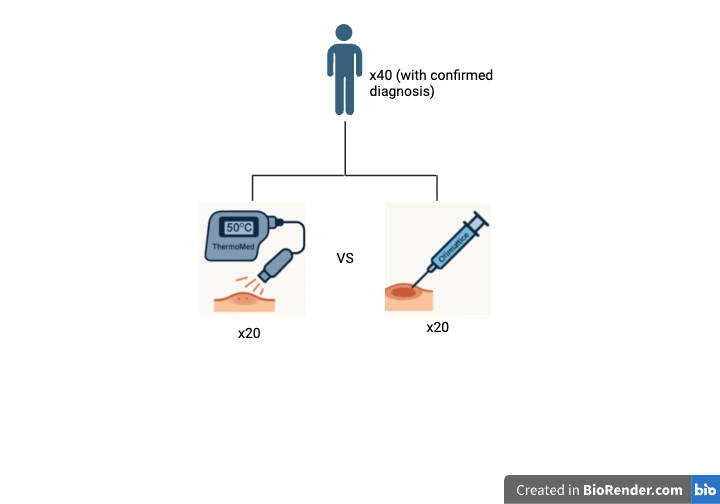
To compare the therapeutic efficacy of thermotherapy vs Glicantime®, researchers performed a pilot study.In this study, 40 participants were enrolled, with 20 in the Glucantime® group and 20 in the thermotherapy group. There were no statistical differences in baseline characteristics including age, sex distribution and lesion number and size.
Regarding lesions, the thermotherapy group experienced a significantly greater reduction in the first lesion at 6 months when compared to the Glucantime® group. Additionally, the firmness was also significantly improved at 6 months. Firmness was measured through clinical palpation by a dermatologist and measured on a 3-tier scale. Grade 1 is soft and the lesion depresses with pressure whereas Grade 3 is a dense and hardened lesion. A soft lesion is a good prognostic factor that the lesion will heal without complications. Other measures such as lesion size and firmness at 3 months and characteristics of the second lesion showed no differences between the two treatment groups.
Ultimately, this study shows that there is therapeutic potential of thermotherapy, particularly as a substitute for Glicantime® therapy for those who have contraindications, where supply is limited, or it is too expensive for patients. Thermotherapy also requires a shorter time and is less painful . As this was a pilot study, more studies with a greater sample size will need to be conducted. Additionally, this was a study conducted in a single location with a single Leishmania species, thus it may not be generalizable to other regions with differing environmental and genetic factors. However, this result was promising and warrants further exploration as a potential treatment going forward.
Link to the original post: Safiabadi, F., Reihani, A., Khajeh, A.G. et al. Comparison of the efficacy of local thermotherapy versus Glucantime® in the treatment of anthroponotic cutaneous leishmaniasis: a pilot study. Parasitol Res 124, 102 (2025). https://doi.org/10.1007/s00436-025-08551-8
Featured image: Sandfly undergoing thermotherapy | Credit: DeepAI









 micro-bites.org