

Breaking down the microbiology world one bite at a time
Fungi in Space
Fungi have a remarkable ability to survive in the most extreme of conditions, one of which is space. However, not much is known about the impact of the space environment on fungal organisms. This is of vital importance in order to understand how to best protect our astronauts and other individuals from fungal organisms as space exploration becomes more accessible in the future.
For this particular study, researchers utilized the fungal organism, Cryptococcus neoformans, an encapsulated organism that most devastatingly causes cryptococcal meningitis. People most susceptible to this pathogen are those who are severely immunocompromised, such as patients undergoing chemotherapy, taking immunosuppressive drugs, or people living with HIV. Research has shown that even spaceflight can induce an immunocompromised state, making studies like these of even more importance. Studies have also confirmed the presence of Cryptococcus species in the International Space Station.
To conduct this investigation, researchers used a 3D clinostat, which is a device that can mimic the conditions of space flight by creating a simulated microgravity environment. The biological sample, in this case C. neoformans, is placed in the device and rotated multidirectionally, continuously and randomly, which helps to simulate microgravity.
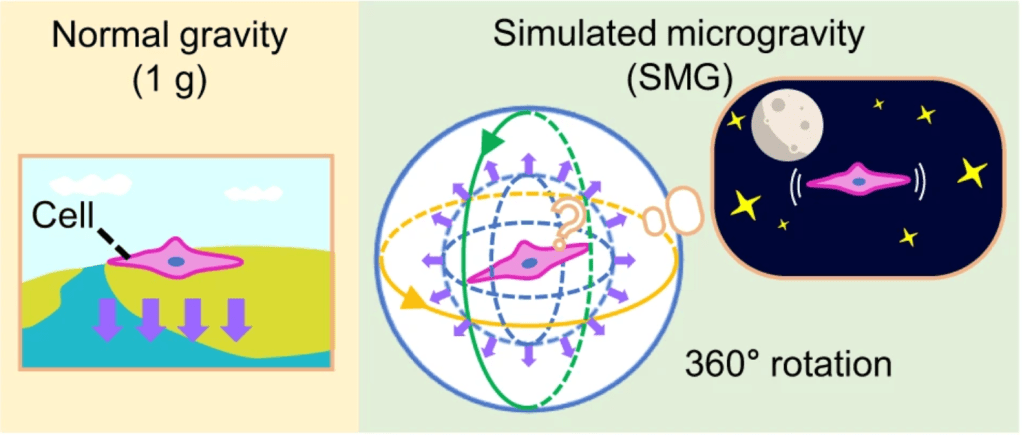
What researchers discovered was that simulated microgravity (SMG) enhanced membrane stress tolerance and osmotic stress tolerance in all 3 strains of C. neoformans tested. Essentially, in an SMG environment, the C. neoformans membrane was able to withstand greater forces on the membrane as opposed to C. neoformans at normal gravity. Continuing from this observation, the researchers tested the efficacy of the recommended antifungals for cryptococcal meningitis, amphotericin B (AMB), fluconazole (FLZ) and 5-fluorocytosine (5FC). These antifungals target the fungal cell wall and membranes. While no microgravity effect was seen with FLZ or 5FC, AMB had increased efficacy in SMG conditions, meaning C. neoformans growth was more inhibited in SMG + AMB conditions. This is potentially due to the fact that C. neoformans in SMG had a greater percentage of an important membrane component, ergosterol, which is the target of AMB, leading to increased efficacy.
Additionally, the researchers found that SMG conditions promoted the virulence factors of C. neoformans, including capsule formation and polymorphism, melanin production and urease secretion. Each of these 3 factors plays a vital role in the pathogenicity of C. neoformans and its ability to cause cryptococcal meningitis. This was further explored using C. elegans nematodes, which were infected with C. neoformans strains under normal gravity and SMG conditions. Under SMG conditions, the nematodes had decreased survival, pointing to the increased pathogenicity and virulence of the fungus.
Thus, fungal pathogenicity in space remains a biosafety concern. The data shown in this study indicates that microgravity environments have the potential to increase the pathogenicity of fungi, thereby posing a serious threat to future space explorers. Although more studies are needed to determine mechanisms and possible treatments, this study definitely deserves more attention from a biosafety perspective.
Link to the original post: Phetruen T, Thongdechsri S, Khongthongdam M, Channumsin S, Meemon K, Chanarat S.2025.Effects of simulated microgravity on biological features and virulence of the fungal pathogen Cryptococcus neoformans. Appl Environ Microbiol91:e01435-25.https://doi.org/10.1128/aem.01435-25
Featured image: Fungi in Space | Credit: Perchance








 micro-bites.org