

Breaking down the microbiology world one bite at a time
Have We Always Been Alone?
While presently the cold, dry, desert environment of Mars is likely uninhabitable for any known forms of life, evidence suggests there was once liquid water flowing on its surface, forming channels and canyons still visible today. This past water activity has been the key motivation for making Mars the prime target in the search for life outside of Earth.1, 2 To find evidence of past Martian life, Mars missions have searched for signs in the rock record.
Evidence of Ancient Life
On Earth, evidence of early microbial life can come in many forms. Microfossils are preserved microbe remains due to rapid burial in sediment or self-entombment in minerals produced as byproducts of their metabolic activities.3 Certain sedimentary structures formed by microbial activity can be preserved in the fossil record such as stromatolites (Figure 1), layered formations that are created through an interaction between microbial biofilm and the surrounding sediment.4 “Molecular fossils”, molecules with complex chemical structure typically associated with life, can be identified in sedimentary rocks.3 Biominerals, minerals formed by living organisms, could also be found in the fossil record. These minerals often have different morphology from their abiotic (not life associated) counterparts. For microbes, these minerals may be formed as a result of byproducts from their normal metabolic processes interacting with compounds in their environment.5
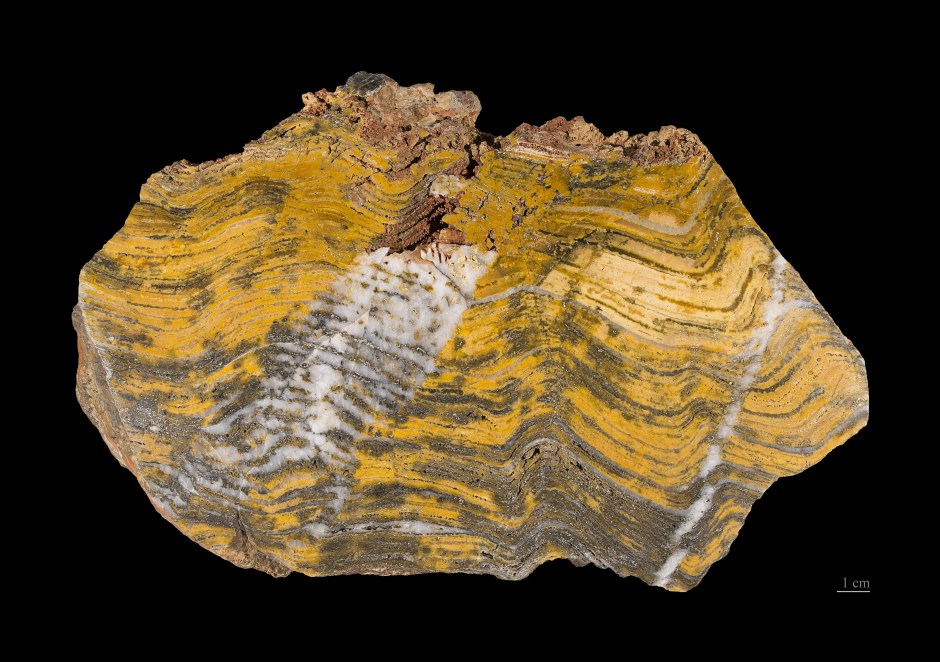
A potential biosignature could include any of these or other structures or substances that might indicate the presence of life.6 As there is a whole host of potential biosignatures to look for on a Mars mission, research must be done to know which to look for. These potential biosignatures must be likely to be found in a more extreme environment like Mars and must be reasonably attributed primarily to life, or in other words, be rarely or never associated with abiotic formation.
Model Martian
In this study, the researchers worked with the Antarctic bacterium Shewanella to investigate potential biosignatures produced from microbial iron reduction that could be identified during a Mars mission. Being an Antarctic microbe, this species of Shewanella is adapted to an extreme environment, which might make it a better representative for extraterrestrial microbes. It is also a well-established model organism for studying bacterial iron reduction.
Iron reduction is believed to be an ancient respiratory pathway for microbes on Earth and a potential one for extraterrestrial microbes.7 In typical respiration, glucose is broken down to generate energy; in the process, electrons are donated to a designated electron acceptor, usually oxygen.8 Under anaerobic conditions (without oxygen), iron reduction involves Fe3+ acting as an electron acceptor and converting to Fe2+ outside of the cell. Fe2+ can react with chemicals in the microbe’s environment, which could form particular biominerals.7
Shewanella was given ferrihydrite, a mineral containing Fe3+ abundantly found in Martian dust.9 Goethite and magnetite were generated, which have been detected in predicted Martian lake basins. Unfortunately, because these minerals could also be formed abiotically, they would not be clear biosignatures unless identified with additional ones.
The researchers also detected high concentrations of riboflavin, which acts as an electron shuttle, transferring electrons from cell membrane proteins to external electron acceptors, such as Fe3+. They argue that detecting riboflavin in addition to Fe mineral deposits such as goethite and magnetite could act as a potential biosignature for extraterrestrial iron reduction.
The Right Tools for the Job
Throughout their experiment, the researchers employed the techniques currently used on Mars missions, as well as analyses they believe would be best suited for future missions. They argue that methods such as X-ray diffraction and Raman spectroscopy are not specific enough to detect minute differences between biotic and abiotic minerals necessary for efficient life detection missions. They suggest much more specific techniques such as Gas- or Liquid-Chromatography-Mass Spectrometry and Transmission Electron Microscopy, need to be further developed to be used on Mars; otherwise samples would need to be returned to Earth or the Mars mission would need to be crewed.
The Future at Hand
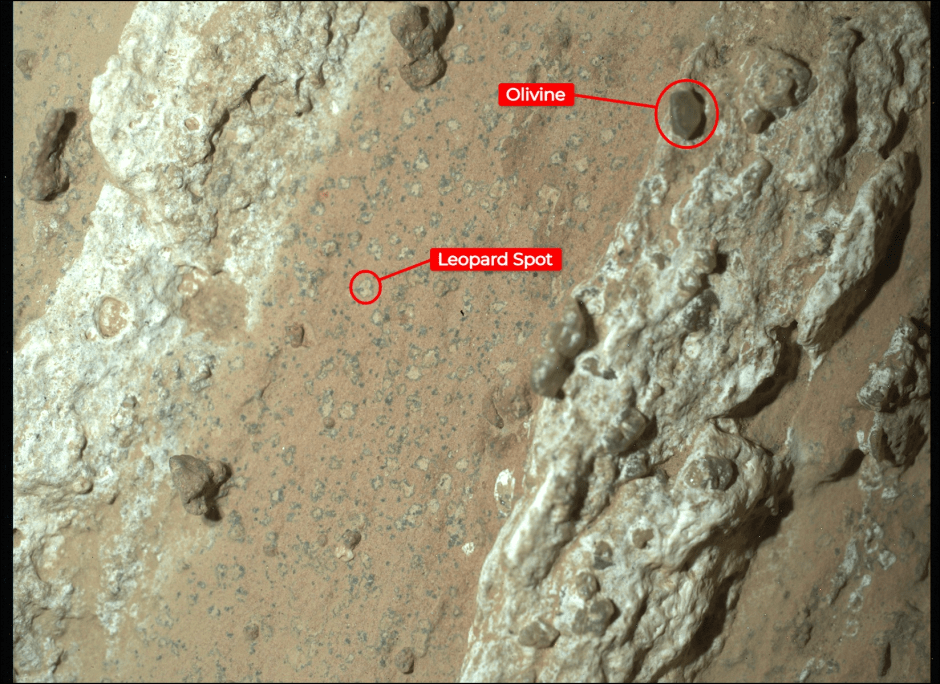
The idea of life outside of Earth sounds nearly fantastical, yet the future discovery of ancient Martian life might be closer than previously thought. In July 2024, NASA’s Perseverance Mars rover came across a unique rock within a predicted ancient dry riverbed in Jezero Crater. Marked with leopard spots, the rock (Figure 2) was found to have two iron-rich minerals: vivianite and greigite, which could be formed by microbial life. In September 2025, a Nature paper claimed these as potential biosignatures; samples were taken that will be analyzed on Earth with more specific techniques.10, 11 While these biosignatures differ from the ones proposed by Shaffer et al., it highlights the importance of expanding Martian mission analytical techniques and of knowing what to search for when it comes to potential biosignatures, lest they be missed amongst the rocks.
Featured image: Created by the author with Clip Studio Paint













 micro-bites.org