
Breaking down the microbiology world one bite at a time
The impact of microplastics on the plankton microbiome
You have probably heard microplastics, and the way they impact our environment and health. But did you know that microplastics also affect plankton? And that microplastics, plankton, and microbes share a complex relationship? That’s what the research from this paper shows.
Plankton
Plankton are organisms living in water or air that cannot move against the current. Bacterioplankton are all the bacteria living in the water, whereas zooplankton are planktonic organisms that have to eat other organisms in order to survive.
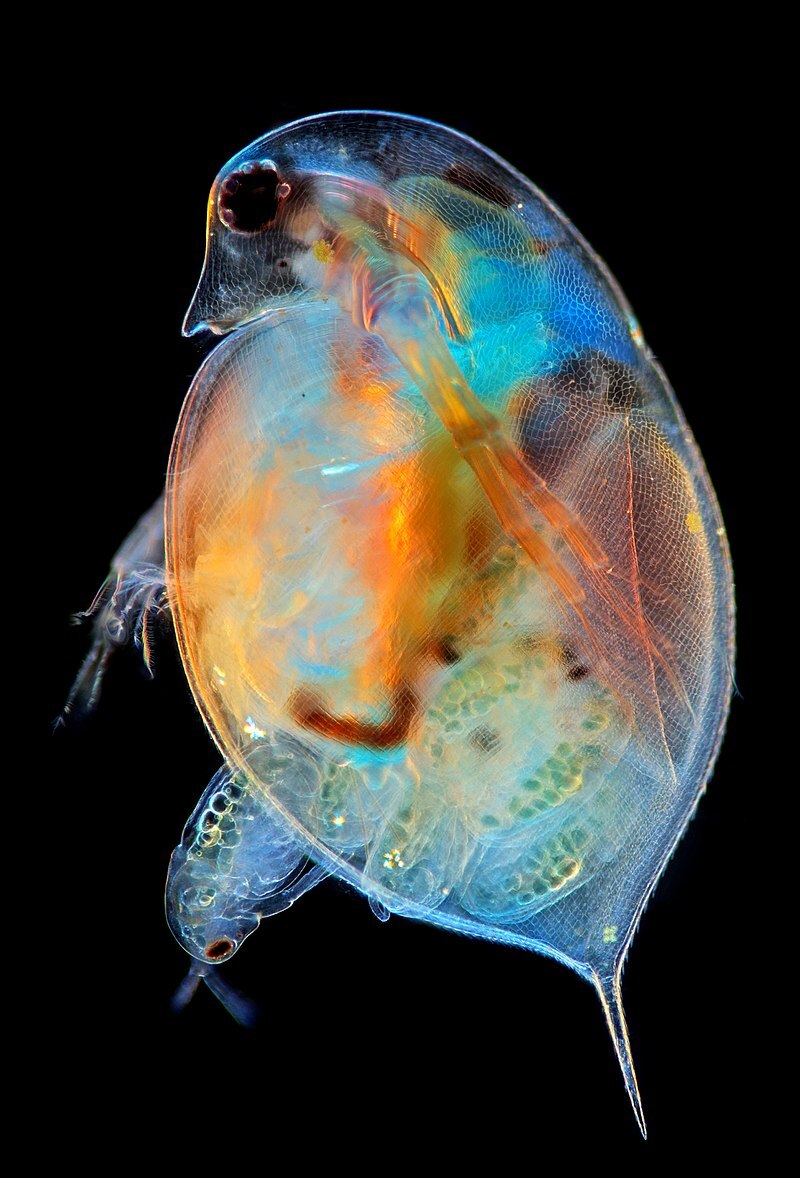
Meet Daphnia, a tiny member of the zooplankton community feeding on even tinier floating particles such as organic particles, algae, and bacterioplankton. Because the food of this crustacean essentially consists of tiny floating particles, it is specifically sensitive to microplastics that can accumulate in its body.
Microbiome
Another important fact about Daphnia is that it has a microbiome, a collection of microbes living in its body and impacting its ability to survive and reproduce. The way that the composition of this microbiome is determined is not entirely clear yet, but it is clear that it is a mix of bacterioplankton species from the surroundings and natively present microbes selected by factors like Daphnia’s diet, its genetic background, and the environmental conditions.
Life in the plastisphere
The microplastics accidentally consumed by Daphnia are populated by the plastisphere, an ecosystem of bacterioplankton living on plastic particles. These bacterioplankton are adapted to their plastic environment: they contain genes that can help them degrade plastic, and genes that give them antibiotic resistance.
By ingesting microplastics, Daphnia also ingests the bacterioplankton living on them, and some of them will become part of Daphnia’s microbiome. The researchers of this paper wanted to understand the influence of microplastics and their plastisphere on Daphnia’s microbiome. Does life in the plastisphere change the microbes living in this organism’s body? And what role do bacterioplankton play in this relationship?

On-site vs. in glass
To answer this question, the researchers did two types of experiments. An in situ and an in vitro experiment. An in situ experiment is an experiment where the samples are taken on-site. For this investigation, the researcher went to ponds with different quantities of microplastic and looked at both the bacterioplankton and the Daphnia microbiome. An advantage of this kind of in situ study is that it reflects reality well, but a difficulty is that the results are sometimes hard to interpret. If one were to find a difference in Daphnia microbiome between one pond and another, it could be due to the microplastic content, but also because of their location or other unknown factors.
That’s why the researchers also executed an in vitro (“in glass”) experiment in the lab, in which they mixed bacterioplankton from different ponds with Daphnia and controlled amounts of different types of plastic. Given that the mixes were then kept in the lab under identical conditions for each mix, differences in outcome could be more easily attributed to either the bacterioplankton mix or the type of microplastic.
From genes to understanding
To find which microbes were present in the bacterioplankton and the Daphnia microbiome, the researchers used 16S rRNA gene amplicon sequencing, a technique used to identify and classify bacteria by analyzing a specific region of their genetic material, the 16S ribosomal RNA gene.
The researchers also used whole genome shotgun sequencing, a method where the entire DNA of an organism is randomly broken into small pieces, which are then sequenced and reassembled to reveal the complete genetic blueprint. This method allowed them to compare the genome of the microbiome to genes that are known to be present in a plasticky environment, such as antibiotic resistance genes and plastic degradation genes.
Choosing a microbiome
Let’s have a look at what they found. First of all, the 16S rRNA sequencing of the in situ experiment showed that there was a significant difference between the composition of bacterioplankton and the Daphnia microbiome: the bacteria living in Daphnia’s surroundings are not the same as those living in its body. Instead, the Daphnia microbiome was confirmed to be a mix between bacterioplankton and species that are natively present in the tiny organism’s body.
Interconnected ecosystems
The whole genome shotgun sequencing showed a difference in the genes that were present in the Daphnia microbiome from low plastic and high plastic ponds. The Daphnia microbiome in ponds with lots of plastic contained more antibiotic resistance genes, and genes involved in PET metabolism.
The in vitro study gave a possible mechanism for the way plastics affect the Daphnia microbiome. After exposing a mix of bacterioplankton and Daphnia to different plastics for 23 days, there was no difference in the Daphnia microbiomes of non-exposed and plastic exposed Daphnia (see image below). However, there was a difference between the Daphnia microbiome before versus after the experiment, regardless of the presence of plastics. This seems to indicate that the main factor influencing the Daphnia microbiome are the bacterioplankton around it, and not the amount of plastic. It therefore seems that plastics impact the bacterioplankton, which in turn change the composition of the Daphnia microbiome.

An important conclusion, that reinforces the idea that ecosystems are highly interconnected and that human activity impacts even the smallest organisms on our planet.
Featured image: https://en.wikipedia.org/wiki/Daphnia#/media/File:Rodz%C4%85ca_dafnia.jpg








 micro-bites.org
