

Breaking down the microbiology world one bite at a time
Coffee: Fueling Your Morning and Your Microbes
Many people around the world wake up and immediately reach for a hot cup of coffee. Whether it is the flavor, the aroma, or the boost in energy to jump start one’s day, coffee consumption has become a routine of life. In the US, nearly 75% of people drink coffee every day, with similar statistics seen in other westernized countries.
Coffee, and its raw bean form, have notable health benefits, like reducing inflammation and activating the immune system to fight off disease, in addition to many other protective properties. However, with so much focus on gut health recently, scientists wondered what effect coffee was having on our intestinal microbiome. In a recent study, scientists found that coffee drinkers have a unique gut bacterium, Lawsonibacter asaccharolyticus, that is fueled by the breakdown of coffee in our gut. This is the first time a dietary item is directly linked to a specific microbe!
To get started, the team of researchers analyzed the metagenomes of over 54,000 people from the US and UK. Additionally, the team analyzed the gut microbes of a few apes, curious if there were any correlation in our ancestral species. Paired with an extensive food survey to document long term dietary consumption of 23,000 participants, they found a strong correlation between coffee drinkers and non-coffee drinkers. With the ape control group, which did not consume coffee, the team concluded this finding is due to modern diet.
Dissecting the coffee-drinking group more, the researchers split the data into three categories: never, moderate, and heavy coffee drinkers. They then analyzed the gut microbiomes of these categories and found that coffee drinking creates distinct profiles of bacteria in the gut.
Specifically, they found a shocking absence of one species of bacteria in the ‘never’ category that was 4x present in the ‘moderate’ and ‘heavy’ category. It is rare to have one species of bacteria completely removed from a population, especially a population that only differs in coffee consumption.
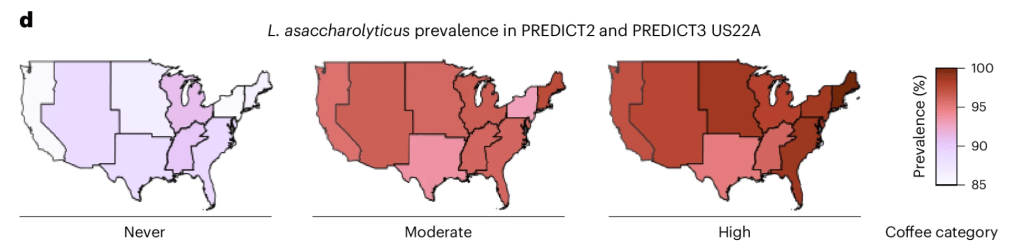
This mystery bacteria, Lawsonibacter asaccharolyticus, was first isolated from human feces in 2018, and is a relatively new microbial species to be investigated. It is known to produce butyrate, a common fatty acid produced in our GI tract that has many well known benefits, like reducing inflammation, reducing the risk of colon cancer, and even improving sleep. But how does coffee affect the growth of this microbe?
They grew the bacteria in broth supplemented with different types of coffee, prepared using different methods. Indeed, the higher the coffee amount, the more the bacteria grew.
To rule out the effects of caffeine, the team compared decaffeinated and caffeinated coffee consumption data. They found the presence of this bacteria to be independent of caffeine. Undeterred, the scientists set out to find what component of coffee L. asaccharolyticus, was consuming.
It’s known that chlorogenic acid, one of the main chemicals in coffee, can be broken down into caffeic acid and quinic acid by gut microbes. They found high amounts of quinic acid in coffee drinkers carrying L. asaccharolyticus, so perhaps chlorogenic acid is fueling L. asaccharolyticus.
The scientists are busy following up on the connection between coffee, health, and L. asaccharolyticus, but they do state that this microbe is an indicator of a healthy GI system. So the next time you sit down to have your morning cup of Joe, think about how your little L. asaccharolyticus working hard in your gut.
Link to the original post: Manghi, P., Bhosle, A., Wang, K. et al. Coffee consumption is associated with intestinal Lawsonibacter asaccharolyticus abundance and prevalence across multiple cohorts. Nat Microbiol 9, 3120–3134 (2024). https://doi.org/10.1038/s41564-024-01858-9
Featured image:





 micro-bites.org