
Breaking down the microbiology world one bite at a time
Probiotics: future of food safety?
Food has a long journey before it reaches our plates: the time it takes for the seed to grow into a harvestable crop – which is then processed in factories – is long, resource-consuming, and laborious. If you are familiar with a documentary series called Food Factory which airs on National Geographic, you would know that they visit some of the largest manufacturing units and processes of food items and explain what it takes to manufacture a safe-to-consume product.
Usually during food processing, physical and chemical methods like dehydration, freezing, high concentrations of salt, canning etc are enough to stop microbial and fungal activity in said food, making it safe to consume. Aspergillus, a type of fungi, on the other hand, is a challenge. Some species of this mold thrive on various food items and crops, favouring hot and humid conditions. It affects cereal grains, legumes, and tree nuts more than the other crops. This widely spread fungus is a health hazard to humans and livestock as it produces a toxic secondary metabolite, aflatoxin.
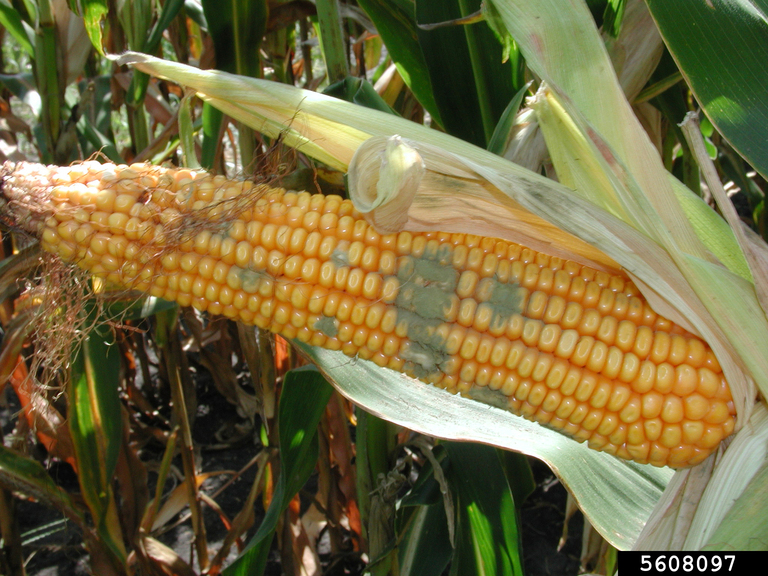
Aspergillus flavus Gary Munkvold, Bugwood.org
Exposure to aflatoxin will not only make you visit the loo but is known to cause liver toxicity and immune suppression. It also has mutagenic (capability of inducing genetic mutations) and carcinogenic (cancer-causing) properties. Not eating cereal crops prone to this infection might not be the safest choice to avoid getting sick. When aflatoxin B1(AFB1), a potent carcinogen produced by Aspergillus flavus and Aspergillus parasiticus, is consumed by any livestock, it gets converted into aflatoxin M1 and can be found in the milk. Moreover, animals cannot digest aflatoxin B1 (AFB1) causing it to be stored in their meat.
AFB1 also shows high thermal and mechanical stability making it difficult to remove from contaminated food by the current physical and chemical methods. Additionally, some methods employed to prevent contamination by fungus and aflatoxin are non-biodegradable.
A team of researchers in Iran explored the potential antifungal activity to address this issue. They isolated probiotic bacteria from the genus Lactobacillus from traditional fermented yoghurt samples to test their antifungal and antibacterial activity and assess other factors like their survival in the gut and safety aspects like antibiotic resistance.
Only two isolates of Lactobacillus (ABRIIFBI-6 and ABRIIFBI-7) demonstrated good survival in an acidic and bile-rich environment (representing the gut) and were chosen to test their antifungal activity. Lactobacillus strains may limit fungal growth by producing secondary metabolites such as organic acids, bacteriocins, and hydrogen peroxide. They discovered that both ABRIIFBI-6 and ABRIIFBI-7 inhibited the growth of A. flavus but ABRIIFBI-7 only slightly inhibited the growth of A. niger while ARBIIFI-6 efficiently inhibited the growth of A. niger.

This study identified bacterial Lactobacillus strains isolated from a dairy product that show promising antifungal activities against Aspergillus. This opens doors to exploring their use as a biological control method for preventing aflatoxin contamination in food. Future research can investigate the potential health benefits of these Lactobacillus strains in animals and how they might contribute to lower aflatoxin levels in milk and meat.
A lot of exciting research is ongoing, exploring the antifungal activity of plant-derived compounds. Natural compounds derived from plants like cinnamon, clove, carrom seeds, mandarin orange, dill, holy basil, coriander and others were tested against A. flavus fungi in different food systems like wheat, corn, chickpea, and tomato. These plant-derived natural compounds or essential oils displayed good antifungal and anti-flatoxigenic activities against A. flavus. Moreover, these compounds benefit the human body, making them safe and natural antifungal agents. So why aren’t we using these compounds to combat aflatoxin? They have shortcomings like low water solubility, long-term storage instability, susceptibility to oxidation, and fast degradation. Researchers are working on nanoencapsulation of bioactive compounds and nanoemulsification of essential oils, demonstrating efficient and targeted use of antifungal agents.
Plant compounds and essential oils can be combined with antifungal drugs and/or probiotics potentially intensifying the effects of fungicides, lowering the dosage levels required to control the pathogens, and reducing the costs and risks of drug resistance development in both food and fungi.
Still, there is a long way to go before using biocontrol methods becomes mainstream. Should we expect these methods to become conventional in the near future?
Link to the original post: Mahjoory, Y., Mohammadi, R., Hejazi, M.A. et al. Antifungal activity of potential probiotic Limosilactobacillus fermentum strains and their role against toxigenic aflatoxin-producing aspergilli. Sci Rep 13, 388 (2023). https://doi.org/10.1038/s41598-023-27721-1
Featured image: Crop Protection Network https://www.ipmimages.org/browse/detail.cfm?imgnum=5608097
Other References:
- https://www.natgeotv.com/za/shows/natgeo/food-factory
- https://en.wikipedia.org/wiki/Secondary_metabolite
- https://www.sciencedirect.com/science/article/pii/S0003267022006894
- https://www.ncbi.nlm.nih.gov/pmc/articles/PMC9774910/#:~:text=Aspergillus%20flavus%20is%20a%20facultative,pathogen%20that%20causes%20aspergillosis%20diseases.
- https://www.mdpi.com/2079-6382/10/1/31
- https://www.sciencedirect.com/science/article/abs/pii/S0308814623004971







 micro-bites.org