
Breaking down the microbiology world one bite at a time
Martian Microbes? The Case of Jezero Crater
A dried-up river delta has recently shown signs of ancient microbial life. While this seems like an ordinary, expected finding, it has the global astrobiological community in a frenzy. Because the dried-up river delta is actually the Jezero crater, on Mars.
These findings mark the first detection of organics in context with potential biominerals. While Perseverance has analyzed the minerals, it has also packaged them to be picked up and studied in depth on Earth. If astrobiologists confirm these minerals as biosignatures, this would be the first independent origin of life.
We might have had neighbours, cosmic, tiny, numerous, bog-bound neighbours that derived energy from iron and sulphur. While the Jezero crater has long been a hotspot for astrobiological research, having once contained water, Perseverance has only recently found organic carbon together with iron- and sulfur-based minerals on mudstones within the crater. These ferrous iron phosphate and sulfide minerals have been identified as likely vivianite and greigite, respectively.
Earthly Mirror:
Vivianite and greigite, back on Earth, are mostly found in specific microbial habitats. These microbes harvest energy by tapping into redox gradients: they oxidize organic matter or hydrogen and, in turn, reduce compounds like sulfate (SO₄²⁻ → S²⁻) or ferric iron (Fe³⁺ → Fe²⁺). In doing so, they release the reduced ions into the environment, where they interact with other minerals to precipitate as vivianite and greigite. The microbes, thus, alter their environment to create a suitable spot for the formation of these minerals.
Bacteria such as Geobacter and Magnetospirillum fill muddy sediments with the reduced iron and sulfide needed to build these minerals. Lakes, river bottoms, peat bogs: those are their playgrounds. Jezero Crater once hosted a lake that could have offered the same style of cold, oxygen-poor habitat where such microbial chemistry thrives. The twist is that Mars doesn’t need life to set up a reducing environment. Vivianite and greigite can still form through purely chemical, non-microbial routes.
Cosmic Trick-or-Treat
Evidence in support of a microbial pathway is compelling; mineral nodules appear in patterns that suggest biological influence, the temperatures inferred were low enough for living chemistry, and the organic carbon nearby could have fueled metabolism. Together, they build a strong case for ancient alien microbial life. But researchers remain careful; this isn’t the first time Mars has teased us with the promise of friendly neighbours. The famous 1996 “fossil bacteria” in the ALH84001 meteorite that landed in Antarctica later turned out to be mineral shapes that geology could probably make on its own. Even methane in the Martian atmosphere, once hailed as a microbial whisper, now seems to spike and fade through chemistry we still don’t fully understand.

Jezero Crater. NASA/JPL-Caltech/MSSS/JHUAPL
Even in the light of these tricks, the current findings are stronger than previous ones. Perseverance is a far more capable laboratory than its predecessors. It carries advanced instruments to detect organics, characterize minerals at fine scales, and cache samples for eventual return to Earth. The mineral samples from Jezero have been tubed up, ready to be collected by the Mars Sample Return mission, so they can finally be assessed with cutting-edge instruments, which could clarify if these minerals are truly of microbial origin.
Here’s why this matters: If these tiny miners once tunneled through Martian mud, then life would no longer be a rare accident. It would be a habit. The answer to this question could spark thousands more, each more exciting than the last. If these minerals are the work of ancient microbes, where are they now? Have they given way to more intelligent forms of life? If not, why did they perish? Was their biochemistry the same as ours? If so, do we share a common origin of life? If not, how many different bases of life could there possibly be? The resolution of this mystery could redefine the next few decades of astrobiology, guiding us as we study our new, microscopic neighbours.
Link to the original post: Hurowitz, J.A., Tice, M.M., Allwood, A.C. et al. Redox-driven mineral and organic associations in Jezero Crater, Mars. Nature 645, 332–340 (2025). https://doi.org/10.1038/s41586-025-09413-0
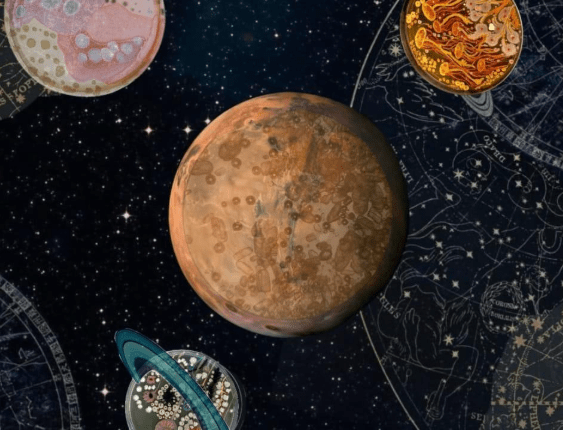
Featured image: original collage made by author







 micro-bites.org