

Breaking down the microbiology world one bite at a time
The dark side of plastic-degrading bacteria in healthcare
Bacteria that degrade plastics? It sounds like a breakthrough, but there’s a darker side to this evolution. In healthcare settings, plastics are ubiquitous in furniture, medical equipment, and implants such as catheters. The risk of these plastics becoming infection sites is already a significant concern. However, some environmental bacteria have developed the ability to degrade plastics using enzymes they produce. This means they can degrade medical implants, which compromises their integrity, or facilitates bacterial growth.
Discovering Pap1: The plastic-degrading enzyme
Researchers from the UK screened clinical bacteria for the presence of plastic-degrading enzymes. They compared the genomes from 19 common healthcare-associated bacteria with sequences from 23 known plastic-degrading enzymes. They identified an enzyme called Pap1 in a variant of the bacteria Pseudomonas aeruginosa (hereafter called PA-W23), which looked similar to the plastic-degrading enzyme PET5. This enzyme is known to break down polycaprolactone (PCL), a biodegradable plastic commonly used in medical devices.
Functional validation of Pap1
The researcher cloned the Pap1 gene into an expression vector, which is a tool used to introduce and express a specific gene in a host organism. This vector was transformed into E. coli to test its functionality on agar plates containing the PCL plastic. The E. coli host expressing Pap1 formed clear zones on the PCL-agar plates, indicating PCL degradation. A control E. coli host carrying the empty vector showed no PCL degradation. Pap1 was shown to be similar to other plastic degrading enzymes, but with improved ability to degrade PCL thanks to a change in one of the enzyme’s building blocks.

Testing in native host
The PA-W23 bacteria itself was also tested for PCL-degrading activity. Astonishingly, it was able to degrade PCL with 78.4% weight loss in 7 days! This means the bacterium can use plastic as a carbon source, essentially “eating” the plastic to survive and grow. Scanning electron microscopy images of PCL beads exposed to the bacteria showed deep pits and cavities, indicating a substantial degradation.

Biofilm formation and virulence
Cultures of PA-W23 and a Pap1 deletion mutant (a variant of the bacteria unable to make the Pap1 enzyme) were grown overnight with and without PCL beads. Afterwards, the researchers looked for biofilm formation on the beads. A biofilm is a group of bacteria that stick together on a surface and produce a slimy layer, which protects them from antibiotics and the immune system, making infections harder to treat.The presence of PCL significantly enhanced biofilm formation, but this biofilm was reduced in the Pap1 deletion mutant, highlighting Pap1’s role in biofilm enhancement.
The PA-W23 became more harmful when a PCL implant was present in a living model of larvae (Galleria mellonella Larvae). This suggests that when these bacteria can break down and live on a plastic implant inside a host, it makes the infections worse.

Incorporation of PCL breakdown products into biofilms
To understand how this enhanced biofilm formation is established, the researchers looked at the breakdown products of the plastic. The breakdown product, 60H-HA, was present in higher concentration in PA-W23 biofilms. The concentration of 6OH-HA in the biofilm produced by the PA-W23 variant without the Pap1 enzyme dropped by approximately 98%.
The discovery of Pap1 and its role in plastic degradation by Pseudomonas aeruginosa PA-W23 highlights a significant clinical challenge. While the ability to degrade plastics might seem beneficial, it poses a threat to the integrity of medical devices and increases the risk of infections. This study underscores the importance of screening for plastic-degrading enzymes in pathogens in clinical or healthcare settings to mitigate infection risks. Future research will study how Pap1 works and how it is controlled, to find ways to stop these threats.
Link to the original post: Howard, S. A., et al. (2025). “Pseudomonas aeruginosa clinical isolates can encode plastic-degrading enzymes that allow survival on plastic and augment biofilm formation.” Cell Reports: 115650. DOI: 10.1016/j.celrep.2025.115650
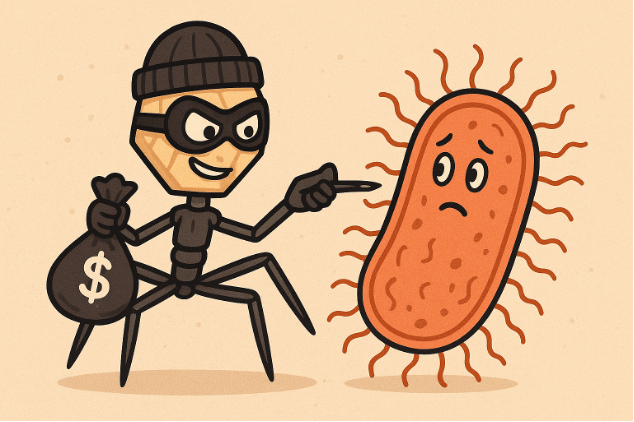
Featured image: Figure created by the author using CanvaPro.






 micro-bites.org