
Breaking down the microbiology world one bite at a time
How the Zika virus turns human skin into a mosquito magnet
Infections with the Zika virus (ZIKV) usually result in mild symptoms, but they can be particularly harmful during pregnancy. An infection during pregnancy can lead to microcephaly, a condition where the baby’s brain has fewer cells than normal, resulting in a smaller head and brain. Additionally, Zika virus can cause Guillain-Barré syndrome, a nerve disorder that leads to muscle weakness or paralysis, often accompanied by sensory issues like numbness or tingling.
ZIKV has been a significant health concern in recent years, especially due to its increased geographical spread across the Americas, Southeast Asia, and parts of Africa. This recent study of Mozūraitis et al. has uncovered fascinating insights into how the ZIKV manipulates human skin to enhance its transmission.

Transmission of ZIKV
The virus is primarily spread by the Aedes mosquito, which bites infected individuals and then transmits the virus to others. These mosquitoes breed in standing water and are active during the day and night. Zika can also be transmitted through sexual contact. The virus can be passed on even if the infected person does not show symptoms. This asymptomatic transmission poses a significant challenge for public health efforts, as it allows the virus to spread undetected. As pregnant women and their unborn children are particularly at risk, understanding and mitigating the spread of ZIKV is crucial for protecting these vulnerable populations and preventing large-scale outbreak and spread of the virus.

The study
Researchers from various institutions, including the Liverpool School of Tropical Medicine and Stockholm University, conducted a study to investigate how ZIKV affects human skin cells, specifically dermal fibroblasts. These cells play a vital role in maintaining the skin’s structure and function. They are directly involved in the initial stages of ZIKV transmission. After a bite with an infected Aedes mosquito, the virus is injected into the skin and first encounters the skin cells. There the virus will replicate and spread. Understanding these early stages of infection and the underlying biological processes are crucial in developing targeted strategies to interrupt the transmission cycle of the virus.
The researchers cultured human dermal fibroblasts in the lab and infected them with the virus. This controlled setting allowed them to observe the direct effects of the virus on these skin cells. They used advanced techniques such as RNA sequencing and proteomics to analyze changes in gene and protein expression in the infected fibroblasts. RNA sequencing examines the transcriptome, which is the complete set of RNA transcripts produced by the genome. This allowed the researchers to identify and quantify RNA molecules, providing insights into gene expression changes caused by ZIKV infection. Proteomics on the other hand is the large-scale study of proteins, particularly their structures and functions. By using mass spectrometry, the researchers could analyze the protein expression profiles of the infected fibroblasts, identifying changes in protein levels and modifications.
Next, they performed a meta-proteome analysis to examine the interaction between different types of genes and proteins within the infected cells. This provided a detailed view of how the virus manipulated the skin cells at both the transcriptional (RNA sequencing) and translational (proteomics) levels. They found that ZIKV infection leads to significant changes in the gene and protein expression of dermal fibroblasts, which means that the virus alters the normal functioning of these skin cells.
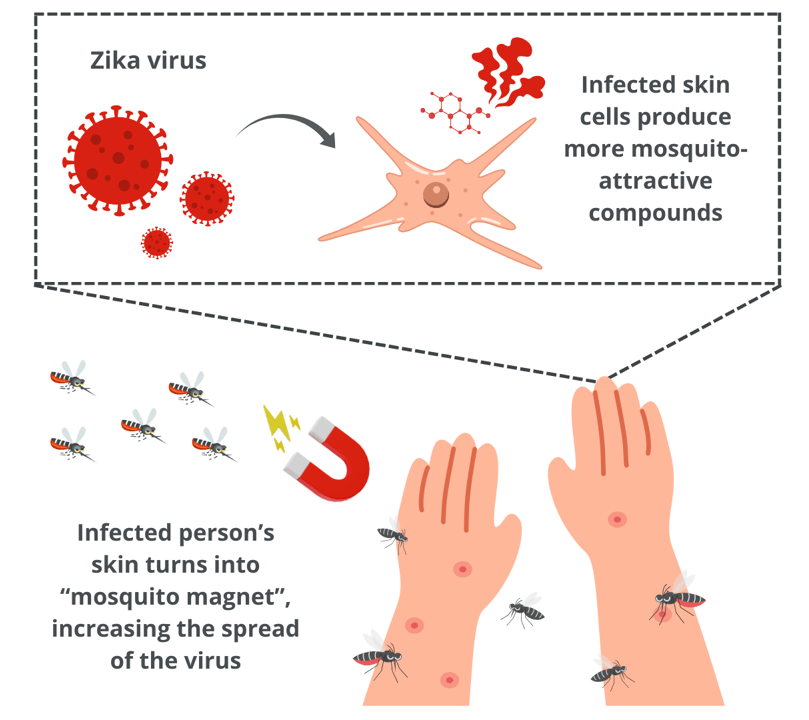
The researcher then measured the production of volatile organic compounds (VOCs) by the infected skin cells. VOCs are chemicals that can attract mosquitoes. To measure these compounds, the researchers used gas chromatography-mass spectrometry (GC-MS), a technique that allows for the separation and identification of different VOCs. An intriguing find was that ZIKV infection increases the production of VOCs by the skin cells, making the skin more appealing to mosquitoes. In this way, the ZIKV essentially turns the infected person’s skin into a “mosquito magnet”.
These findings expose a mechanism of enhanced ZIKV transmission. By increasing the production of mosquito-attractive compounds, the virus enhances its chances of being picked up by mosquitoes and transmission to new hosts. This sneaky manipulation helps the virus spread more effectively.

Why this matters
Understanding these mechanisms is crucial for developing new strategies to combat the ZIKV and possibly other mosquito-borne diseases. By targeting the production of VOCs or disrupting the virus’s ability to manipulate skin cells, researchers could reduce the transmission success of the virus.
In conclusion, this study sheds light on the cunning ways ZIKV ensures its survival and spread. The findings open up new avenues for research and potential interventions to control the spread of Zika and similar viruses.
Featured image: Mechanism of enhanced Zika virus transmission. Figure created by the author using CanvaPro.









 micro-bites.org