
Breaking down the microbiology world one bite at a time
From Superfood to Super Vaccine?
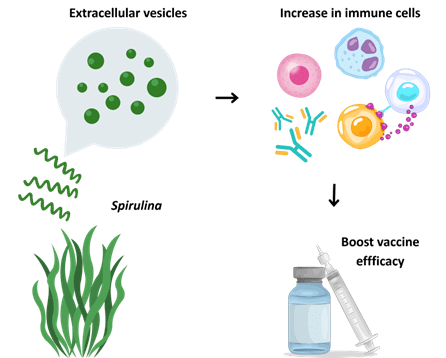
Spirulina, an edible cyanobacterium, is often hailed as a ‘superfood’ due to its rich nutritional profile. It is recognized to have multiple therapeutic benefits like reducing blood lipids, controlling diabetes, improving cardiovascular health and anti-inflammatory effects but it might also hold the key to new medical advancements. Namely, researchers have discovered that Spirulina produces tiny particles called extracellular vesicles (EVs), which could revolutionize vaccine development.
Isolating Spirulina EVs
The researchers suspected that Spirulina, like other microorganisms, might produce EVs. These EVs are small, bubble-like structures that play a crucial role in communication between cells, carrying proteins, lipids, and genetic material [1]. Advances in technology and growing interest in the potential health benefits of EVs prompted them to explore this previously unstudied area. In this study, researchers reported for the first time the isolation, characterization and visualization of EVs from Spirulina.
To ensure no other microorganisms were present, the Spirulina filaments were sonicated and grown on medium in a petri dish. Single colonies were selected and transferred to a flask with medium in a photobioreactor to provide consistent light (Figure a). The researchers then used a combination of low-speed centrifugation steps to remove large cellular debris, filtration and concentration to concentrate the EV containing fraction, and ultracentrifugation (a very high speed-centrifugation) to pellet the EVs. The EVs were further purified by size exclusion chromatography, a technique where the sample is passed through a column loaded with a matrix (Figure b). Larger particles cannot enter the pores of the matrix and will move faster through the column then smaller particles that can enter the pores and have a longer retention time. The researcher used a very powerful microscope to visualize and examine the EVs.

Testing the effects on mice
Given that EVs play an important role in cell-to-cell communication and because previous studies have shown that EVs can influence immune responses and have potential applications in immune therapies [2], the researchers investigated how immune cells respond to EVs from Spirulina. Mice injected with these EVs showed significant increase in immune cells, indicating a strong pro-inflammatory response. The researchers reported no signs of toxicity or allergic reactions. They injected mice with these EVs in two ways: some mice were injected daily for two days to study short-term effects, while others got injections every three days for a longer period to study long term effects.
After the injections, they examined the immune cells in the mice. They found that certain immune cells, like neutrophils and type 1 macrophages, increased at the injection site. However, other cells, like conventional type 1 dendritic cells, decreased. In the spleen, the number of type 1 macrophages was lower. Interestingly, mice that received long-term injections had more helper T cells, which are important for fighting infections. Finally, they checked the lipopolysaccharide (LPS) content in the EVs, which can cause inflammation. Although the levels were elevated, the EVs didn’t trigger significant inflammatory responses in the cells tested. The observed response is similar to how certain adjuvants, substances added to vaccines to enhance the body’s immune response to the vaccine, work to stimulate immune responses.
Boosting vaccine efficacy
Researchers hypothesized that Spirulina-derived EVs could enhance immune responses to vaccines by increasing type 1 macrophage levels and thereby boosting the vaccine’s effectiveness. To test this, they gave mice a model vaccine antigen (Sh-TSP-2) mixed with EVs from Spirulina and measured the levels of specific antibodies in the mice’s blood.
The results showed that mice receiving the Spirulina-derived EVs adjuvanted vaccine had over 100 times increased production of antibodies compared to those receiving the vaccine without Spirulina-derived EVs or with another type of EVs. Antibodies are proteins released by immune cells that specifically target and neutralize pathogens, helping to fight infections. More antibodies mean a quicker and stronger immune response, leading to a shorter duration of illness. Vaccines mimic this process by pre-exposing the immune system to a harmless part of a pathogen, thereby building up antibody production and preparing the body for future encounters with the actual pathogen. Although the antibody levels were slightly lower than those induced by a well-known adjuvant (alum/CpG), the Spirulina-derived EVs still produced a strong immune response. This suggests that Spirulina-derived EVs contain molecules that can safely boost the immune response to vaccines.
Why does it matter?
Spirulina is readily available and easy to grow, making it a cost-effective alternative to current adjuvants. By harnessing the superpower of Spirulina, this research could potentially lead to more effective, safer, and affordable vaccines, which is a significant advancement in public health.
Featured image: Figure created by the author using CanvaPro.






 micro-bites.org