

Breaking down the microbiology world one bite at a time
The newest Antarctica resident: the H5N1 bird flu virus
Most likely you have heard several news reports about avian flu that is resulting in massive mortality in chicken farms and among wild birds. But what is causing this? The highly pathogenic avian influenza virus (HPAIV) H5N1 emerged in 1996 in China. Since 2020, a variant of this virus has led to outbreaks in wild and poultry birds, first in Africa, Asia, and Europe. In 2021, the virus reached North America, and in 2022, Central and South America (WHO). Although some cases of HPAIV H5N1 have been reported in humans, the risk of becoming a human virus, such as what happened with COVID-19, is still very low. However, it has created a big concern for the WHO and the scientific community because the virus is infecting a large number of wild and domestic animals, including birds and mammals, indicating great adaptability to different hosts.
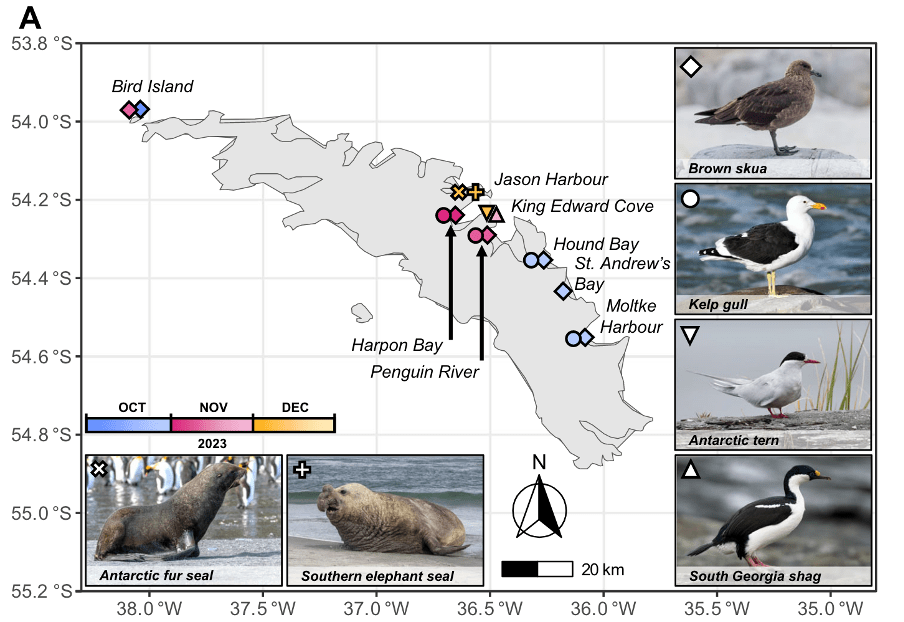
A recent study by Banyard, et al showed for the first time the presence of HPAIV H5N1 in animals from Antarctic regions, such as Brown skua, Kelp gull, Antarctic tern, South Georgia shag, Southern elephant seal, Antarctic Fur Seal, Black-browed albatross, and Southern fulmar. The study was performed in South Georgia and the Falkland Islands, close to the Patagonia region, in October through December 2023. Although the authors tested penguins on these islands, they were negative for the presence of the virus; however, another study by Fabiola León, et al. suspects that penguins and shags from the continental Antarctic are infected with H5N1, suggesting the virus arrived in the region by other routes.
When the researchers analyzed the virus’s origin in both islands, they found it came from the virus that circulated in South America in 2022 to 2023, most likely from Argentina, Uruguay, Peru, and Chile. Interestingly, they also found that once in South Georgia Island, the virus spread across the land and diversified the hosts it can infect, indicating the great adaptability of the H5N1 virus. The study suggests that this happens because many birds have migratory pathways that help the virus quickly spread across different geographic regions.
In addition, many of these birds live in crowded colonies, facilitating the spread between specimens and increasing the probability of transmitting it to other bird species. While this virus does not normally infect mammals, fur and elephant seals can be infected by eating sick birds. The HPAIV H5N1 has been shown to produce important mortality events in fur and elephant seals. However, no changes in the viral genome associated with mammal adaptation have been detected, which indicates it is not likely to infect humans. In addition, these islands are an important ecosystem since they are home to protected species such as the penguins. Nevertheless, the virus has shown very low or no risk for them.
This study provides important evidence about how H5N1 virus spread around the world, even in far lands such as the Antarctic region, and highlights the importance of monitoring this virus in different species to prevent the jump to humans. After all, the great flu pandemic in 1918, was produced from a H1N1 avian virus origin.
Featured image: Image source: Bing Image creator











 micro-bites.org