
Breaking down the microbiology world one bite at a time
Too Much of a Good Thing: Excess Serotonin Damages the Gut
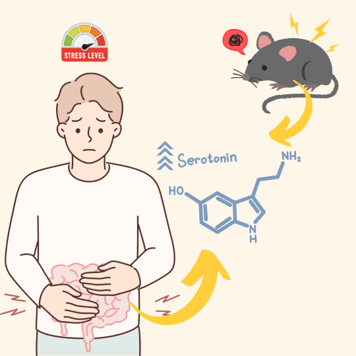
Early life experiences leave lasting marks on our bodies, often in ways we don’t immediately recognize. A recent study from researchers in China reveals how stress in infancy can affect gut health, highlighting new avenues for understanding and treating gastrointestinal disorders. Using a mouse model of neonatal maternal separation (separating pups from their mother for a few hours a day), which mimics early life stress, the study delved into the gut-brain connection and uncovered a surprising culprit behind the dysfunction: serotonin.
Serotonin, a molecule commonly associated with mood regulation, also plays a critical role in gut health. The researchers found that early stress led to elevated serotonin levels in the intestines of the affected mice. While serotonin is essential for digestion under normal conditions, its overproduction caused disruptions in gut structure and function. These disruptions mirrored the symptoms of irritable bowel syndrome (IBS), a condition that causes intense stomach pain and digestive issues. Interestingly, IBS often affects people with a history of early stress or trauma. The stressed mice showed heightened gut sensitivity, accelerated intestinal transit times, and increased inflammation. This can look like: diarrhea, stomach pains and bloating, all hallmarks of IBS.
One striking finding was how serotonin influenced the gut’s nervous system. Excess serotonin activated a signaling pathway called Wnt, which stimulates the growth of new neurons (neurogenesis). While neurogenesis is typically a beneficial process, in this case, it led to an imbalance in the gut’s neural network. The overabundance of excitatory neurons caused excessive gut motility and hypersensitivity, throwing the system into disarray. Similar to trying to drive a car with only an accelerator and no brakes. Additionally, the gut’s protective barrier, which prevents harmful substances from entering the bloodstream, was weakened in the stressed mice. This allowed inflammation to take hold, making the problem even worse.

The researchers also explored how changes in the gut microbiome contributed to the problem. The bacterial community in the intestines of the stressed mice shifted, with specific species becoming more abundant in response to elevated serotonin levels (Faecalibaculum). These microbial changes likely played a role in the observed symptoms by potentially amplifying some of the inflammatory signals in the gut. This highlights the intricate relationship between gut bacteria, serotonin, and intestinal health.
Perhaps most encouragingly, the study identified a potential solution. By using a drug that inhibits serotonin production, the researchers were able to reverse many of the negative effects seen in the stressed mice. Mice felt less stomach pain, intestinal motility normalized, and the integrity of the gut barrier improved. This suggests that targeting serotonin could be an effective therapeutic approach for stress-related gut disorders like IBS.
This research underscores the profound impact of early life experiences on physical health. While much attention has been given to the effects of childhood stress on the brain, this study reveals how it can also shape the gut in lasting ways. Though this study focused on mice, its implications for humans are significant. Understanding the role of serotonin in these processes opens the door to new treatments that could improve the lives of millions of people suffering from IBS and similar conditions. Scientists may one day develop targeted therapies to help those affected by childhood stress heal—not just emotionally, but physically too.
Link to the original post:
Yang D, Bai R, Li C, Sun Y, Jing H, Wang Z, Chen Y, Dong Y. Early-Life Stress Induced by Neonatal Maternal Separation Leads to Intestinal 5-HT Accumulation and Causes Intestinal Dysfunction. J Inflamm Res. 2024 Nov 19;17:8945-8964. doi: 10.2147/JIR.S488290. PMID: 39588137; PMCID: PMC11586501
Featured image:
Created by author using Canva Pro.
Additional sources:
Komiya Y, Habas R. Wnt signal transduction pathways. Organogenesis. 2008 Apr;4(2):68-75. doi: 10.4161/org.4.2.5851. PMID: 19279717; PMCID: PMC2634250
Loh, J.S., Mak, W.Q., Tan, L.K.S. et al. Microbiota–gut–brain axis and its therapeutic applications in neurodegenerative diseases. Sig Transduct Target Ther 9, 37 (2024). https://doi.org/10.1038/s41392-024-01743-1
Cleveland Clinic. What is Serotonin? (2025) https://my.clevelandclinic.org/health/articles/22572-serotonin
National Institute of Diabetes and Digestive and Kidney Diseases (NIDDK). Irritable Bowel Syndrome. Web. (2025) https://www.niddk.nih.gov/health-information/digestive-diseases/irritable-bowel-syndrome#:~:text=Irritable%20bowel%20syndrome%20(IBS)%20is,disease%20in%20your%20digestive%20tract
Kara Bradford, Wendy Shih, Elizabeth J. Videlock, Angela P. Presson, Bruce D. Naliboff, Emeran A. Mayer, Lin Chang, Association Between Early Adverse Life Events and Irritable Bowel Syndrome, Clinical Gastroenterology and Hepatology, Volume 10, Issue 4, 2012, https://doi.org/10.1016/j.cgh.2011.12.018








 micro-bites.org