
Breaking down the microbiology world one bite at a time
Can Antibiotics Be Our New Ally Against Viral Infections?
Respiratory viruses are a significant public health threat, as they can spread rapidly and cause severe illness. Examples include seasonal influenza and Severe Acute Respiratory Syndrome Coronavirus (SARS-CoV-2), both of which have caused global pandemics. While vaccinations, such as the annual flu shot, help reduce the severity of illness, there remains an urgent need for broader-spectrum antiviral treatments or preventive measures that can target multiple respiratory viruses effectively.
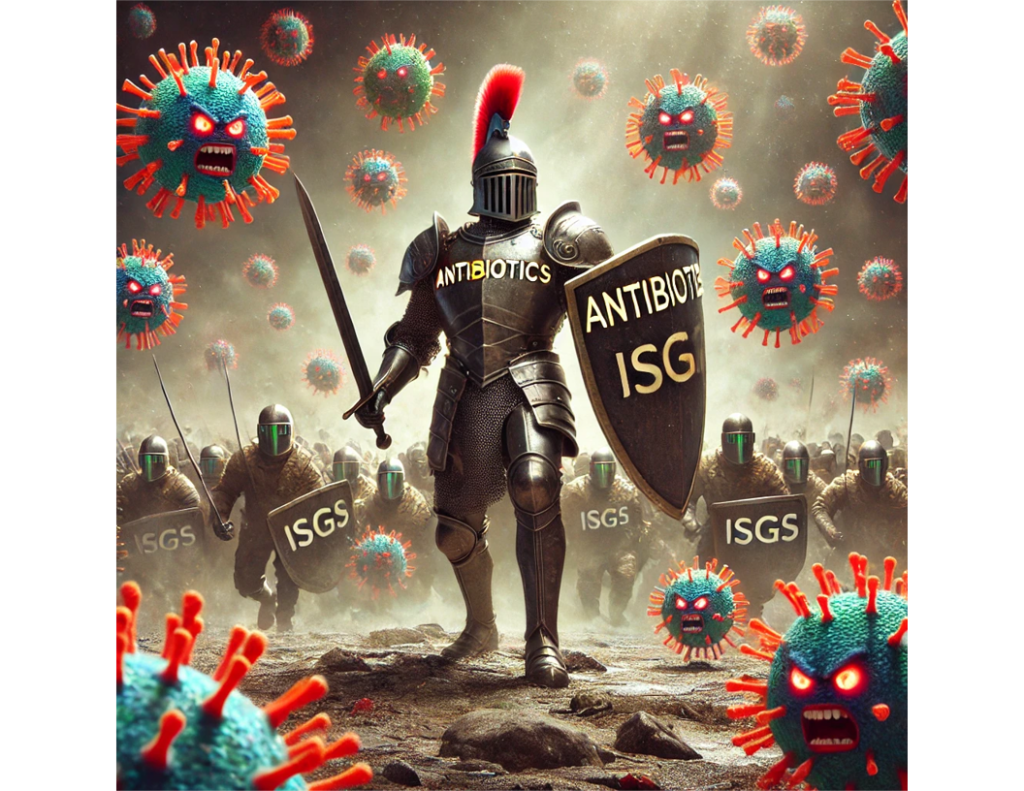
Interferon-stimulated genes (ISG) is a critical host defense against viral infection
In vertebrates, when the host is infected with viruses, the host cells will secrete a small signaling molecule called interferon (IFN). IFNs are regarded as the first line of defense against viral infection, and can be categorized into three different groups- type I (e.g. IFN-α or IFN-β), type II (IFN-γ), and type III IFNs (IFN-λ). When IFNs bind to the receptors present on their neighboring cells, an antiviral state will be established by induction of myriads of genes termed as interferon-stimulated genes (ISG). While many of these ISGs are known to have antiviral functions, the regulation of ISG expression is still not fully understood.
Neomycin can induce expressions of antiviral genes and protect a wide range of animals from respiratory viral infection
One way to alter ISG expression is the use of common antibiotics. In fact, a study has reported that the application of a specific antibiotic called neomycin on the intravaginal region can induce ISG expression and antiviral response against both DNA and RNA viruses, which are composed of DNA or RNA molecules respectively. By building upon these findings, a study group from Yale university examined whether the application of neomycin can also trigger an antiviral response by induction of ISGs in the nasal regions of the host.
To answer this question, the research group treated their study animals with neomycin in their intranasal cavities. Remarkably, application of neomycin in both mice and hamsters can trigger antiviral response. Several antiviral genes, like Isg15, which encodes a factor that is critical for activation of antiviral proteins to inhibit viral replication, were elevated in these animals administered with neomycin intranasally.
Next, the researchers further explored the molecular mechanism by which ISGs are induced by neomycin. ISGs are often considered a hallmark of IFN response. However, the study group only detected the presence of IFN-γ, but not IFN-α or IFN-β and IFN-λ, both of which are the primary IFNs that account for antiviral defense in the host nasal regions during infection. This result reveals that neomycin-induced ISGs might be mediated by type II IFN. Furthermore, the group also observed increased expressions of antiviral genes in mice treated with neomycin and housed in germ-free facilities. Since neomycin also has bactericidal properties, this observation indicates that neomycin-induced ISG expression is independent of the microbiome, which are trillions of tiny microorganisms that naturally inhabit together with our body.
But can neomycin protect animals from respiratory viral infection?
To address this question, the research team treated the animal with neomycin and subsequently challenged them with respiratory viruses including influenza and SARS-COV-2. Moreover, neomycin also appears to curb viral growth and disease progression associated with influenza or SARS-COV-2 infection, as neomycin-treated animals have less viral load and higher survival rate upon infection.
To test if neomycin can also trigger an antiviral response in a similar fashion in humans, the researchers used an over-the-counter (OTC) ointment, Neosporin, which also contains neomycin. For this experiment, the healthy participants applied either Vaseline (placebo) or Neosporin in their nostrils using a cotton swab. Consistently, the research team observed increased expression of ISGs in nasal brush samples from patients treated with Neosporin in comparison to the placebo group.
So how can these research findings be translated into the clinical setup?
Implication for the study
Given that respiratory viruses remain a challenge to healthcare systems, it is clear that developing effective and accessible antiviral treatments is essential. While certain treatments like recombinant interferon (rIFN) injections can offer protection, they are associated with severe side effects, such as increased inflammatory responses. Furthermore, such treatment is expensive to produce at a large scale, which prompts the need for alternative therapies that are both safe and cost-effective.
Unlike costly rIFN treatments, which often have considerable risk, neomycin—a readily accessible antibiotic—can effectively activate antiviral defenses with reduced side effects. Together, this study not only provides novel insights into how antiviral signaling can be regulated by molecules such as antibiotics, but highlights neomycin as a potential antiviral therapy option for respiratory viral infections.

Link to the original post: Mao, Tianyang et al. “Intranasal neomycin evokes broad-spectrum antiviral immunity in the upper respiratory tract” Proceedings of the National Academy of Sciences, vol. 120, no. 21, 2023, p. e2300320120,
Featured image: image generated from OpenAI












 micro-bites.org