
Breaking down the microbiology world one bite at a time
Alone and Unwell: Microbiome and Metabolic Changes in Female Prairie Voles
Ever wonder how loneliness affects our health beyond just feeling sad? Prairie voles, small rodents known for their loyalty and strong social bonds, provide some surprising answers.
Unlike many animals, prairie voles form lifelong pair bonds with their mates and live in tight family groups, making them an ideal species to study the effects of social isolation. Because of their close-knit nature, separating them from companions can lead to noticeable changes in their behavior and physical health. By studying these highly social animals, a recent study has provided insights into how loneliness can impact not just the mind, but also the body, revealing connections that may be relevant to humans as well.
When researchers compared two groups of female voles—one group housed with a same-sex sibling and another kept in isolation for four weeks—they noticed clear behavioral differences. The isolated voles showed signs of anxiety and depression, such as less time spent in the open arms of the Elevated Plus Maze test and more immobility during the Forced Swim test (see image below). These behaviors show how being alone can put stress on animals’ mental health.
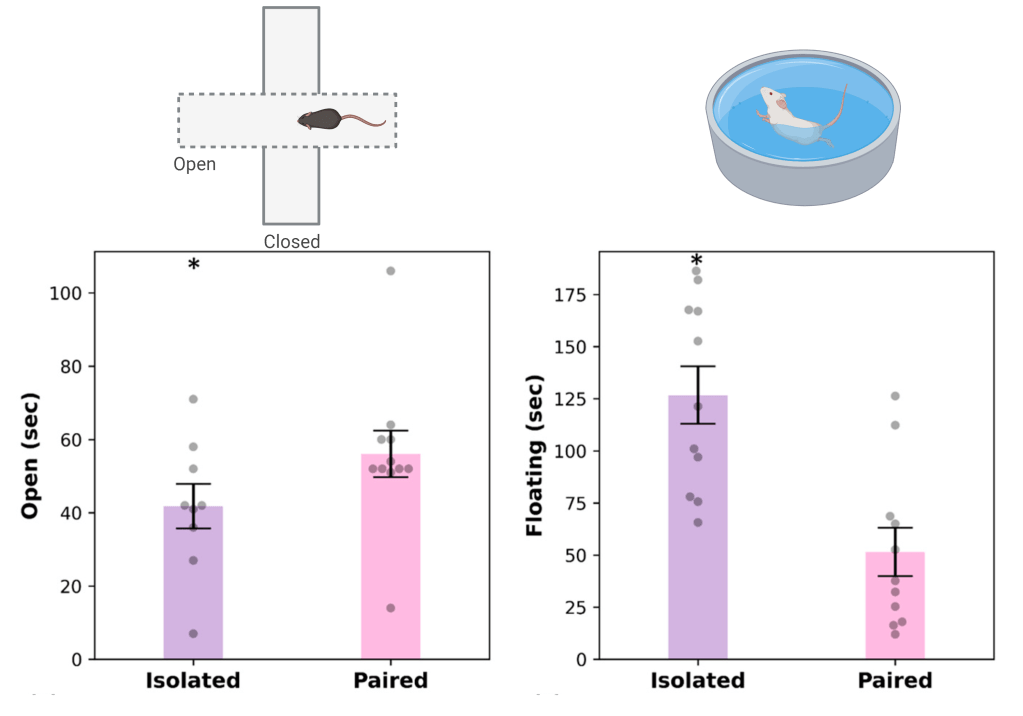
Symbols above the bar graphs are examples of what the behavioral tests look like. The left bar graph represents the results of the Elevated Plus Maze test. The less time an animal spends in the Open Arms, the “more anxious” they are. The right bar graph is the results of the Forced Swim Test. Animals that spend a longer time floating are said to be “more depressed”. Data adapted from Nuccio et al. 2023. Created with BioRender.
The study also found that isolation changed the gut bacteria of the voles. Voles living with companions had more helpful bacteria, such as Anaerostipes and Lactobacillaceae, which aid digestion and protect against harmful bacteria. However, isolated voles had higher levels of bacteria like Enterococcus and Staphylococcaceae, which have been linked to illnesses like digestive problems and diabetes. This suggests that social isolation may lead to unhealthy changes in the gut.
The effects of being alone went beyond the gut. The researchers also noticed differences in the metabolites—small molecules involved in body processes—found in the voles’ feces and blood. For example, isolated voles showed altered levels of metabolites like tetradecanoic acid and butanoic acid. In paired voles, higher levels of these metabolites were associated with spending more time in open spaces during behavioral tests, a sign of reduced anxiety. Tetradecanoic acid, in particular, has been studied for its calming effects, with research suggesting it may help reduce stress.
Meanwhile, butanoic acid, commonly produced by gut bacteria, has shown mixed effects on behavior, reducing anxiety in some studies but increasing or having no effect on depressive behaviors in others. These findings highlight how shifts in metabolism may play a role in the emotional responses triggered by social isolation. Yet, there still needs to be more research in this area to confirm it.
Overall, this study shows how mental health, gut health, and metabolism are closely connected. Social isolation can change behavior, disrupt gut bacteria, and affect body chemistry, increasing the risk of serious illnesses. These results highlight the importance of social interaction for staying healthy. In the future, researchers could look into whether treatments like probiotics might help prevent some of these negative effects.
Link to the original post: Nuccio, D.A.; Normann, M.C.; Zhou, H.; Grippo, A.J.; Singh, P. Microbiome and Metabolome Variation as Indicator of Social Stress in Female Prairie Voles. Int. J. Mol. Sci. 2023, 24, 1677. https://doi.org/10.3390/ijms24021677
Featured image: Created by author in Canva Pro.
Additional sources: Bui TPN, Mannerås-Holm L, Puschmann R, Wu H, Troise AD, Nijsse B, Boeren S, Bäckhed F, Fiedler D, deVos WM. Conversion of dietary inositol into propionate and acetate by commensal Anaerostipes associates with host health. Nat Commun. 2021 Aug 10;12(1):4798. doi: 10.1038/s41467-021-25081-w. PMID: 34376656; PMCID: PMC8355322.
Zawistowska-Rojek, A., Kośmider, A., Stępień, K. et al. Adhesion and aggregation properties of Lactobacillaceae strains as protection ways against enteropathogenic bacteria. Arch Microbiol 204, 285 (2022). https://doi.org/10.1007/s00203-022-02889-8
Fiore E.Van Tyne D.Gilmore MS.2019.Pathogenicity of Enterococci. Microbiol Spectr7:10.1128/microbiolspec.gpp3-0053-2018.https://doi.org/10.1128/microbiolspec.gpp3-0053-2018
Vu BG, Stach CS, Kulhankova K, Salgado-Pabón W, Klingelhutz AJ, Schlievert PM.2015.Chronic Superantigen Exposure Induces Systemic Inflammation, Elevated Bloodstream Endotoxin, and Abnormal Glucose Tolerance in Rabbits: Possible Role in Diabetes. mBio6:10.1128/mbio.02554-14.https://doi.org/10.1128/mbio.02554-14
Contreras, C. M., Rodríguez-Landa, J. F., García-Ríos, R. I., Cueto-Escobedo, J., Guillen-Ruiz, G., & Bernal-Morales, B. (2014). Myristic acid produces anxiolytic‐like effects in Wistar rats in the elevated plus maze. BioMed Research International, 2014(1), 492141.
Gundersen, B. B., & Blendy, J. A. (2009). Effects of the histone deacetylase inhibitor sodium butyrate in models of depression and anxiety. Neuropharmacology, 57(1), 67-74.
Van de Wouw, M., Boehme, M., Lyte, J. M., Wiley, N., Strain, C., O’Sullivan, O., … & Cryan, J. F. (2018). Short‐chain fatty acids: microbial metabolites that alleviate stress‐induced brain–gut axis alterations. The Journal of physiology, 596(20), 4923-4944.




 micro-bites.org