
Breaking down the microbiology world one bite at a time
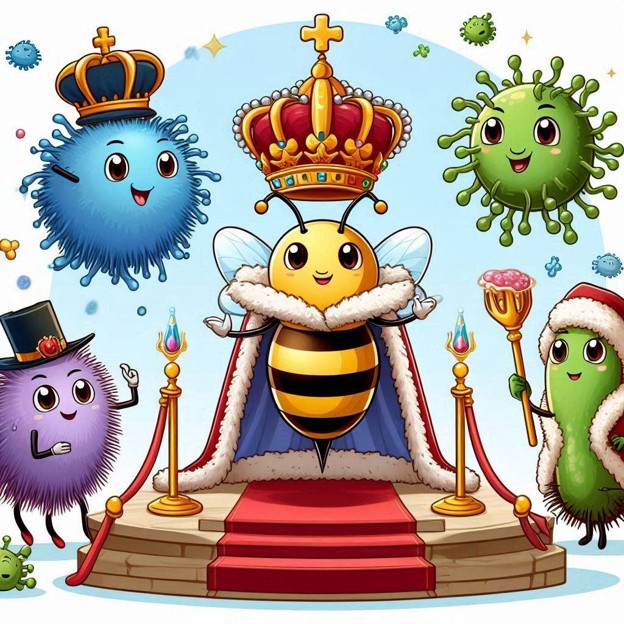
“Royal microbes”, the court of the queen bee
Bees are eusocial insects, meaning they live in groups with “specialized jobs” and proper division of labor for the colony’s survival. In honey bees, as in many other insects with specialized jobs, the queen lays eggs and regulates colony development and behavior. So the health of the queen is vital to guarantee colony success. As in humans, bees also have a gut microbiome, a group of bacteria in the intestine known to modulate several physiological processes to promote health.
Such help from inside the gut not only boosts the immune defense against infections: The bacteria also break down complex nutrients into simpler ones, which can serve as a food source for the host. Thus, investigating which microbes are living in the gut of the bee allows us to understand how the health of bees is impacted.
A recent study published by Caesar et al., 2024, characterized the honey bee gut microbiome. The authors described the whole microbial community inside the gut, including bacteria and bacteriophages (or phages), which are viruses that infect and replicate only in bacteria cells. They showed that in honey bees, the gut microbiome of the queen greatly depends on the environment, including the geographical distribution of the queens used in the study.
The authors also examined the main core of bacteria present at the species level and found that four bacterial species compose the honey bee gut queen microbiome (see the figure below). These species comprise the “Royal microbiome”: Bombella apis, Commensalibacter sp., Apilactobacillus kunkeei, and Lactobacillus apis.

In the royal context, the court includes all the members who influence the queen and the monarchy in different ways, including advising, helping to administer, and supporting the queen to guarantee the monarchy’s wellness. Similarly, the four microbiome species in the queen bees act as “advisors” and provide a nutritional and protective role. They influence several physiological processes, for example, nutrient acquisition and energy metabolism, to promote the queen’s health, thus impacting the health and function of the bee colony.
Another member of the “royal microbiome” are the bacteriophages of the class Caudoviricetes. Bacteriophages are modulators of the bacterial community that selectively kill bacteria and, in this case, disturb the bacterial community in the gut of the bee. Interestingly, the authors found that the healthy queens mostly have more bacteria than phages. However, when there are more phages than bacteria, such queens have compromised health, meaning that the health of the queen correlated with the quantity of the phages (e.g. good health = less phages).
The bacteria species comprising the “Royal microbiome” differ from the worker bees’ microbiome. How have such differences been possible? The answer might be related to the diet and the nutritional resources that the queens require. Since larvae, queen bees are mainly fed royal jelly, which is rich in proteins, fatty acids, carbohydrates, vitamins, minerals, and other nutrients. Some proteins present in the royal jelly can act as immune molecules, called antimicrobial peptides, that inhibit the growth of bacteria.
A possibility that the authors pointed out is that such antimicrobial components in the royal jelly can select the bacteria present in the “royal microbiome” because the antimicrobial peptides in the royal jelly do not kill all the bacteria. In fact, some “Royal microbiome” members can even grow in the royal jelly. In this way, even when queen bees and workers share the same genetic information, the diet (in this case, the royal jelly) shapes their physiology and, simultaneously, the microbiome members that will help them boost their nutritional and immune status.
Overall, with their results, the authors show the importance and implications of studying the honey bee queen microbiome. This work also provides information that can be used by other researchers to apply strategies that might contribute to maintaining a healthy status in bee colonies.
Link to the original post: Caesar L, Rice DW, McAfee A, Underwood R, Ganote C, Tarpy DR, Foster LJ, Newton ILG.2024.Metagenomic analysis of the honey bee queen microbiome reveals low bacterial diversity and Caudoviricetes phages. mSystems9:e01182-23.https://doi.org/10.1128/msystems.01182-23
Featured image: Created using Microsoft Bing









 micro-bites.org