

Breaking down the microbiology world one bite at a time
Chocolate’s delicious aroma and flavor come from microbes’ hard work
Surely you have ever enjoyed a chocolate bar once in your life. Chocolate originates from cacao beans, coming from trees growing in tropical regions such as South America and Africa. In fact, cacao trees originated in the upper Amazon region (Colombia, Ecuador, Peru, and Brazil) based on archeological evidence of domestication and usage of cacao. Cacao is mainly grown on small farms in developing countries from Latin America, Africa and Asia, and its production provides incomes for 40 to 50 million farmers and their families around the global south. There are different cultivars of cacao trees depending on their geographical localization: Forastero, Criollo, Nacional, and Trinitario, a hybrid between Forastero and Criollo. The flavors and aromas we can get in chocolate are also influenced by the genetic and geographic origin of cacao trees.
Chocolate fermentation conditions influence its taste.
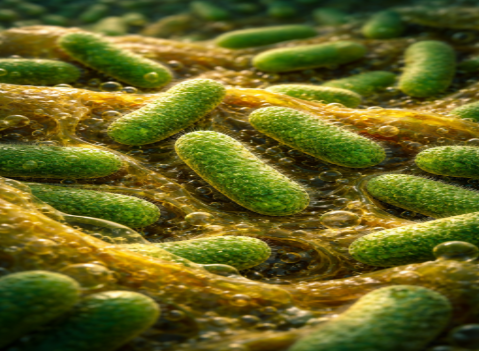
Chocolate is basically made from ground roasted cacao beans but before getting this delicious product, a fermentation process takes place aided by amazing microorganisms. The fermentation process involves several microbes including yeast, lactic acid bacteria (LAB), and acetic acid bacteria (AAB). These microbes consume the pulp surrounding cacao beans and produce acid and other compounds that influence the quality of chocolate. The acid helps the following drying and curing steps since it penetrates and triggers chemical reactions to form the chocolate flavor and eliminates the bitter taste cacao beans naturally have. The fermentation process is commonly carried out in handcrafted, wooden boxes, and its duration and conditions vary considerably from one country to another and even between farmers. Cacao variety and duration of fermentation also influence the taste. The maximum development of aromatic compounds can take 5 to 10 days at temperatures from 40 to 50 °C.
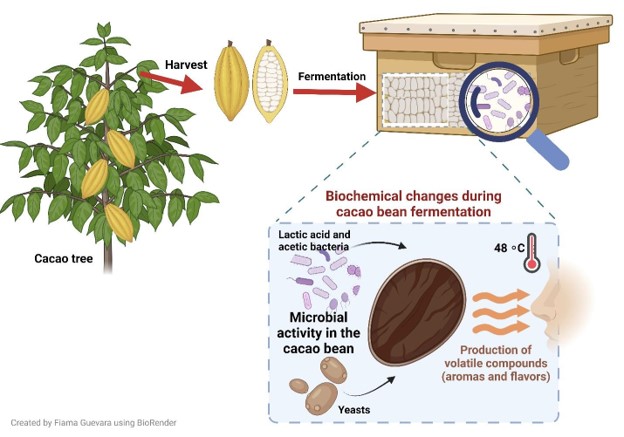
Research on the fermentation process is needed to improve chocolate flavor.
Although fermentation can occur spontaneously and little work is put on by farmers on this matter, one big disadvantage is that cacao flavor and aroma can be inconsistent between farms and batches within a single farm. Such variability underscores the importance of optimizing the fermentation process. One area to consider is selecting specific microbes capable of producing aromatic compounds during cacao fermentation. Another area worth researching is fermentation conditions, mainly to avoid the growth of toxin-producing fungi, reduce fermentation time, and enhance phenolic and antioxidant compounds.
Researchers in Ecuador, where cacao is an economically significant crop in the country’s agroindustry, investigated the diversity of microorganisms during spontaneous fermentation of Nacional x Trinitario cacao beans. This niche cultivar is known as fine aroma cacao and is highly demanded to produce the finest chocolate bars. They were able to isolate, grow and identify over 240 microorganisms from commercial cacao production. Bacteria from the genera Lactiplantibacillus and Acetobacter (47%), and yeasts from the genus Saccharomyces (17%) were the most relevant for fermentation. The growth of these microbes was tested for tolerance to different temperatures and pH levels. In addition, sugars like glucose, fructose, and other compounds were added to the culture medium. Based on their performance and tolerance to different culture conditions, L. plantarum, A. pasteurianus, and S. cerevisiae were selected as the optimal microorganisms for cacao fermentation.
Contributing to more sustainable and economically viable chocolate production
Furthermore, the researchers designed alternative culture media to optimize the growth of the identified bacteria and yeasts. They aim for an economical and environmentally friendly way to reduce costs and impacts associated with cacao fermentation starters. They tested alternative substrates including whey, molasses, and orange pulp, and tested bacteria and yeasts previously isolated using laboratory-scale fermentation experiments. In the end, the researchers’ goal is to improve chocolate flavor profiles through microbial management strategies; thus, they identified the volatile compound profile of cacao during fermentation using L. plantarum, A. pasteurianus, and S. cerevisiae isolates as starter cultures.
The formulated starter culture showed alcoholic compounds, including 2-pentanol, 2-heptanol, and phenylethyl alcohol. These compounds provide a sweet, citric, fruity, and floral aroma. Moreover, fermentation during 120 hours led to the production of ketones that contributed to fruity, spicy, sweet, herbal, coconut, and woody aromas.
As the chocolate industry grows, the demand for high-quality and aromatic cacao beans has increased. The industry has focused on the recovery of “fine” cacao genotypes with desirable aroma and flavor traits; however, this research is an example of the importance of studying and understanding the dynamics of microbial communities involved in cacao fermentation for desired chocolate quality. Tailoring this knowledge with production strategies is necessary for improved chocolate production. Furthermore, this research highlights the potential applications of microbial communities in the chocolate industry, opening a door for innovation and sustainable production.
Link to the original post: Constante Catuto MP, Tigrero-Vaca J, Villavicencio-Vasquez M, Montoya DC, Cevallos JM, Coronel-León J. Evaluation of stress tolerance and design of alternative culture media for the production of fermentation starter cultures in cacao. Heliyon. 2024 Apr 19;10(8):e29900. doi: 10.1016/j.heliyon.2024.e29900. PMID: 38699711; PMCID: PMC11063452. https://www.ncbi.nlm.nih.gov/pmc/articles/PMC11063452/
Featured image: Image created by Fiama Guevara using Canva and Canva’s AI image generator.
Additional references:
Díaz-Valderrama J.R., Leiva-Espinoza S.T., and Aime M.C. 2020. The History of Cacao and Its Diseases in the Americas. Phytopathology. 110:10, 1604-1619.
Zarrillo S., Gaikwad N., Lanaud C., Powis T.G., Viot C., Lesur I., et al. 2018. The use and domestication of Theobroma cacao during the mi-Holocene in the Upper Amazon. Nat. Ecol. Evol. 2:1879-1888.
Zhang D. & Motilal L. 2016. Origin, Dispersal, and Current Global Distribution of Cacao Genetic Diversity. In: Cacao Diseases: A History of Old Enemies and New Encounters. Eds. Bailey, B.A.; Meinhardt, L.W. Springer, pp. 3-33.
Information about Yeasts: https://en.wikipedia.org/wiki/Yeast








 micro-bites.org